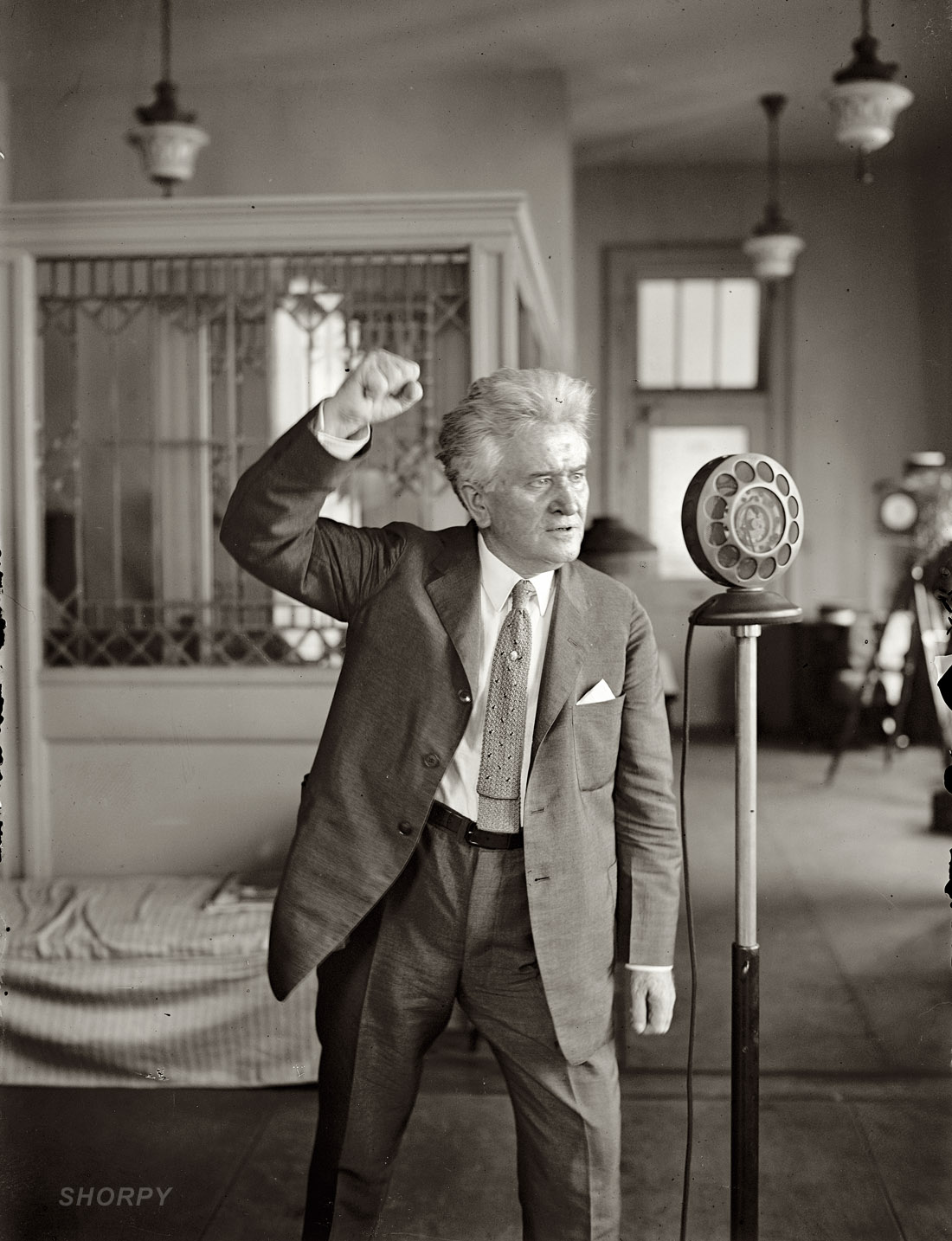
Hannah Arendt never wrote a “moral philosophy.” It is not hidden away in the archives or any of the recent collections of her work, nor in her unpublished lectures, letters, or journals. She was a political theorist who thought that moral philosophy requires a set of social relations that are inaccessible in the modern world. Yet as she has become more popular and is taught more and more often by moral philosophers, she is developing an unearned reputation as a moralist that perverts both what we should mean by moral philosophy and what she hoped to show us about the world we now inhabit.
[caption id=”attachment_3023″ align=”aligncenter” width=”300″] Old Ohio Penitentiary by J. Harris Day[/caption] This semester I taught a course on crime and punishment, and in part out of competition with my colleague Seth Vannatta , I set out to give a final presentation on the dimensions of the course. This is the presentation I wrote. Introduction…
At the beginning of the twentieth century, there was a broad consensus among reformers in the United States regarding the perniciousness of economic monopolies and winner-take-all politics. After that period of rampant growth and cronyism known as the Gilded Age, groups who had been disproportionately disadvantaged by political patronage and voter fraud began to organize…
Last year, I suggested that liberal objections to Citizens United were partly justified by predictions about its effects that I didn’t see as probable . As the election draws to a close, we can begin to say whether the consensus view or my own views were accurate. Here goes: as a percentage of GDP, this is…
The Obama administration brews its own beer Weigel takes a stab at serious policy Weigel has predicated a lot on the conditional statement: “If you look at it right, then you’ll see serious policy.” But we don’t have any evidence for the antecedent, that the public or the media *will* “look at it right.” More to…
It is my considered opinion that the next three months will involve no serious deliberations regarding substantive public policy. Though readership and viewership for such matters will be at its highest, none of the things discussed will be discussed in a way that comports with public reason or with anything like the goal of exchanging…
I’ve been putting off finishing my series on the Bleeding Hearts / Crooked Timber debates, because Chris Bertram had suggested that there might be a reply to critics. Now he says it might be a while longer, so I’m going to finish up. In my last post , I suggested that none of the methods…
The virtue of the Crooked Timber bloggers’ objections to the Bleeding Heart Libertarians’ line is that it implicitly suggests the difference between liberal and republican conceptions of freedom. Libertarians have usually substituted theories of interference and coercion for a full-blown theory of domination. When Chris Bertram stopped by, he suggested that they wanted to avoid…
Let me start with a correction. Anarchy isn’t really as interesting as you think it is. In fact, Anarchy is Boring : Figuring out how to run a sustainable anarchist household (that values time spent washing the dishes and time spent making money as a computer programmer equally) isn’t as headline-grabbing as a downtown smashup….
[caption id=”” align=”alignleft” width=”320″ caption=”Blame it on REM”] [/caption] I had the pleasure and discomfort of attending parts of the Reason Rally on Saturday, a march on Washington by atheists, agnostics, and heathens . It was cold, rainy, and frequently quite boring. I mostly went to see Bad Religion , but I enjoyed Eddie Izzard’s…
This Newsnight piece paints a picture of the widespread breakdown of the Greek social compact: What was no joke were the clashes between police and the hardline protesters.[…] Time and again, on the grounds of confronting the rioters, police made incursions into large masses of peaceful protesters. […]I can tell you from repeated experience, it…
I think about inequality a lot. But I also think about the middle class a lot, which isn’t quite the same thing. Generally, my sympathies lie with the “least advantaged” or “subaltern,” but I also feel the pull of the American cultural commitment to the middle class. There can be little doubt that we are…
(Caveat Lector: I am not a conservative. However, recent reflections on institutional experimentation have reminded me of some of the virtues of the philosophical movement that goes under that name.) With the publication of The Reactionary Mind , Corey Robin has taken up Phil Agre’s old point that conservatism is the defense of aristocracy and…
Most academics know some version of the critique of elite rule, administrative power, and centralized regulation by experts. Hannah Arendt called bureaucracy the “rule of No Man;” Michel Foucault described the overlap of legislative power, knowledge-production, and the apparatus of discipline and control; Iris Marion Young defended simple street activism against the demand that political…
While there is much more to be said about the risks associated with advocating “experimental disenfranchisement,” I stand by the claim that we cannot ignore the widespread temptation towards disenfranchising ignorant citizens. We must at least acknowledge that the challenge is not simply coming from nowhere: Jason Brennan reflects a widespread, even common-sensical, fear of…
Peter Levine’s post on Havel’s 1992 speech in Poland reminded me that I had planned to do some writing about Havel before he died. The New York Times titled his obituary ” A Melding of the Artist’s Politics and the Politician’s Art ,” and yet it focuses only on his writing career and offers not…
So I’ve just completed grading 55 papers on Citizens United v FEC , and though I’d kind of like to reflect on it a bit, I’m also finding that grading has totally exhausted my interest in the legal questions. (But seriously: the personhood question is a red herring!) Maybe later this week I’ll post…
Today Dr. J encourages her readers to understand the Occupy Wall Street movement through the lens of Aristotle’s Metaphysics: The Occupy Movement is like our sense of sight. It’s not (instrumentally) valuable for what it allows us to see, but rather it’s (intrinsically) valuable in that it allows us to see. Like sight, it “brings to light many differences…
Whenever I talk to students about democracy, I like to emphasize that the original term for democratic rule was isonomy . Consider the account Otanes gives in Herodotus’ History : “[T]he rule of the multitude [plêthos de archon] has… the loveliest name of all, equality [isonomiên]…. It determines offices by lot, and holds power accountable, and…
Most discussions of the Commons assume that common-pool resources are supplied by nature, like the English fields that were available to locals for grazing, cultivation, and hay-cutting until the Inclosure Acts . However, it is equally possible to create new common pool resources for local control. Kojo Nnamdi spent an hour on his radio show…
I’ve been looking for good articles on local governance, in part related to the Tufts Summer Institute, and in part related to my goal of transforming my ethics course so that it takes up the paired questions of the Good Life and the Good Citizen. One resource for this is Sharon Meagher’s textbook Philosophy and…
I’ve just returned from two weeks at the Tufts Summer Institute of Civic Studies , which culminated in a conference attended by 117 researchers, practitioners, philanthropists, and public officials interested in expanding the role of citizens in our democracy. Peter Levine summed up the conference here : The Frontiers conference was modeled on No Better…
Consider two courses of action: One has a low probability of success but promises to mildly increase welfare (however defined). Call this “meliorism.” Rawlsian liberals, Burkean and Oakshottean conservatives, and Hayekian libertarians frequently identify with this view. Another has an unknown probability of success, but promises to massively increase welfare (however defined). Call this “perfectionism.”…
Here’s the gist : I would like to argue that most of the really important public policy issues are not even part of the ongoing debate in the press. Here are some examples: 1. The huge rise in occupational licensing. 2. The huge rise in people incarcerated in the war on drugs, and also the…
Scu pointed me to this discussion of a Cap and Trade dividend. One issue, which would also apply to a carbon tax + dividend: this would hit exports but miss imports. Contrast that with a plain-old VAT, which hits imports but is refunded on export. This would make our goods less competitive, while encouraging us to…
You know, I may have been looking at the Basic Income + VAT wrong. Instead of using a value-added tax to fund the basic income, perhaps we should use a basic income grant to sell a different policy… the carbon tax! Here’s what I have in mind: the US could adopt a revenue-neutral carbon tax….
[caption id=”” align=”alignleft” width=”336″] US Customs and Border Protection officers enforce our labor market protections with paramilitary techniques.[/caption] One of my favorite liberal policies is the basic income proposal. The idea is that all citizens have a basic guaranteed income, below which no one may fall. As the argument goes, this supplies more flexibility than…
[caption id=”” align=”alignright” width=”375″ caption=”The Day of Thugs (Image from Foreign Policy)”] [/caption] It is said that revolution is what happens when a police officer is transformed from a legitimate authority into a man with a gun. If that’s true, then what we witnessed in Egypt yesterday is a classic counter-revolution: irregular hoodlums attacking peaceful…
Will Wilkinson on Bryan Caplan’s (false?) dilemma : Bryan Caplan lays down a challenge to liberaltarians: From what philosophic point of view is “maximizing growth + lots of redistribution + the immigration restrictions lots of domestic redistribution naturally encourage” better than “maximizing growth + no redistribution + free immigration”? Whether you’re concern for the poor is…
Thomas Gregersen quotes Ronald Dworkin on Amartya Sen : It is not helpful, in the world of real politics, only to call for due consideration of a large variety of factors that everyone concedes relevant without also offering some overall scheme to suggest how these different factors should be weighted in a practical decision about…
There’s a pretty fantastic exchange happening in the blogosphere right now, started by Freddie DeBoer here and followed-up here . The substance of DeBoer’s criticism is that there are no legitimate “far left” bloggers, only center-left “neo-liberals” and the panoply of social conservatives, partisan Republicans, and libertarians. Thus, DeBoer charges, we have a blind spot,…
In his comments on my post last week , Robin Hanson asked about the conceptual work still needed to advance the cause of prediction markets as tools for governance. To my knowledge, Hanson’s definitive statement of futarchy can be found here : When an approved betting market clearly estimates that a proposed policy would increase expected…
Tyler Cowen, a loyal reader of my e-mails, responds to my question on Michel Foucault . In the process, he recommends The Archeology of Knowledge twice, and notes that Foucault …goes astray by assuming, implicitly, explicitly or otherwise, that structural categories somehow interact with each other in the world of ideas. It’s much more micro and disaggregated…
Hannah Arendt begins The Human Condition with an account of a world in which “speech has lost its power,” where scientific omnipotence is achieved through the manipulation of mathematical equations whose sense escapes even the mathematicians’ capacity to intuit, and the decision to unleash destructive nuclear powers has been foisted upon non-scientists who are even…
Steven Maloney asked his students to stabilize the budget using the CRFB’s simulator . Some couldn’t do it without making draconian choices that were particularly painful for seniors, or undoing the President’s decisions to preserve troop levels in Afghanistan and extending the Bush-era tax cuts. Some wouldn’t do it: That students would hand in deficits…
Hugo Mercier and Helene Landemore describe an evolutionary psychological theory of deliberative polarization in their paper, “Reasoning is for Arguing: Understanding the Successes and Failures of Deliberation.” From the paper: We suggest that the function of reasoning is not the betterment of beliefs and judgments through private ratiocination and this is why reasoning does not accomplish this task well….
If you haven’t read Assange’s own self-justifications , then you can read this summary of them to get a sense of what worried me . Now, Peter Ludlow does a proper study of Assange’s political theory: this is conspiracy in the sense of the original etymology of ‘conspire’ – as in “breathe with” or “breathe together”. …
Megan McArdle discusses budget negotiating strategies . She’s right. Ezra Klein outlines why liberals don’t like it . He’s also right: Obama’s got 156 million people splitting $214 billion in tax cuts and benefits. The GOP’s got 4[.8] million people splitting $133 billion in tax cuts. On a per-person level, the GOP’s tax cuts are…
Charles Stross demands better aspirational fictions : “We need — quite urgently, I think — plausible visions of where we might be fifty or a hundred or a thousand years hence: a hot, densely populated, predominantly urban planetary culture that nevertheless manages to feed everybody, house everybody, and give everybody room to pursue their own…
So far as I can tell, the news coverage of the latest diplomatic infodump breaks along a line orthogonal to ordinary US partisanship. Either: 1. There’s nothing new here, although the possibility of future exposure may hamper diplomatic efforts in the near term. or 2. Secrecy is bad, here are some secrets. Neither perspective is particular…
I didn’t hear Jon Stewart’s speech from the Mall, so his quote about where real Americans live didn’t hit me until today. I’m guessing his claim was designed to set up the old, tired prejudice that the 495 Beltway is some kind of line that separates real Americans from the DC punditocracy. Given his various criticisms…
It was a policy wonk’s rally. People who know too much to think activism can be effective in the current media environment. People who spent the last decade protesting the war or Gauntanamo to no avail, only to watch the Tea Party become a major force with minuscule numbers because of a television network’s support. I think some are confusing the…
He died October 3rd . He had a robust theory of bureaucracy and he worked throughout his life to conceptualize the fundamental disconnect between democracy and totalitarianism. He is perhaps most famous for his book on Machiavelli ( Le Travail de L’Oeuvre Machiavel) which tried to recuperate the political theory from the secular image of “machiavellianism” as…
If you’ve ever been to my home city, Washington, DC, you’ve probably noticed that the license plates say “Taxation without Representation.” That’s because DC residents (like Puerto Ricans and inhabitants of the US territories and “overseas possessions”) are not represented in Congress by voting members. Instead, we have a non-voting delegate , much like the…
Dr. Trott has a nice post over at Mahogany Feed on Terry Jones’ threat to burn Korans over the weekend to commemorate the attacks of September 11th and to remind Muslims “not to push their agenda on us .” Dr. Trott suggests that this threat to burn the holy book of a cultural group, with…
In a post on the fate of the university, Steve writes : We appear to have a situation where the public will not invest in education because it is more concerned in distributing the state’s patronage to older citizens, which has created an education system which has had to cut spending on public service, and…
In the wake of Arizona’s attempt to localize immigration enforcement , I think it’s time for Congress and the Obama administration to return to immigration reform. If anything can justify American exceptionalism , it’s the waves of immigration that have repeatedly demonstrated that we can offer a better life to foreigners without losing our own…
Often when I am trying to explain problems in the modern political landscape or my own approach to political philosophy, I will return to Max Weber’s account of bureaucracy as more efficient than private office. Yes, I’ve heard all the jokes about “efficiency” in bureaucracy, but Weber’s argument rested on the contrast between private and…
Infinite Th0ught offers this op-ed by Alain Badiou : The living proof that our societies are obviously in-human is today the foreign undocumented worker: he is the sign, immanent to our situation, that there is only one world. To treat the foreign proletarian as though he came from another world, that is indeed the specific…
Generally, I respect Harvey C. Mansfield’s work on classical political theory , and think his attempts at contemporary cultural and political criticism are absurdly small-minded. His piece in The Weekly Standard on Obama’s non-partisanship is a mixture of the good Mansfield and the bad Mansfield, so I recommend it to fans of ambivalence. Here are…
I’ve just returned from the Understanding Humans through Neuroscience conference at the American Enterprise Institute , where I heard papers by Roger Scruton, Walter Sinnott-Armstrong, and Stephen Morse. What struck me was how mired the three papers were in defending against a certain kind of agency-undermining determinism that few people take seriously any more. All…
My old boss Ted Kinnaman has a piece in the Huffington Post on Pat Robertson’s claim that Haitians deserved the recent earthquake because they made a pact with the devil in order free themselves from colonial slavery. Others have developed the historical case for such a pact . Where many have taken Robertson to task…
The newest issue of The Good Society has been released, with a symposium my friend Steven Maloney and I put together on epistemic proceduralism. It features contributions by James Bohman , Corey Brettschneider , Noëlle McAfee , and Robert Talisse and Michael Harbour . The ‘utopophobia’ in the title comes from David Estlund’s book Democratic…
In a recent report on British policing , Denis O’Connor criticized the growing use of paramilitary policing in the UK: “British police risk losing the battle for the public’s consent if they win public order through tactics that appear to be unfair, aggressive and inconsistent,” he said. “This harms not just the reputation of the…
In the 1961 case Mapp v. Ohio , the Supreme Court declined to protect the the possession of pornographic material, but instead decided to exclude all evidence gained through unconstitutional searches. Last month, the Supreme Court revisited that decision in Herring v. United States , where they reconsidered the rule of evidence that excludes evidence gained…
The other night I was discussing Lacan with a friend who practices psychotherapy, and he suggested that Lacan’s work ‘only makes sense in the clinic.’ We agreed that when philosophers and critical theorists try to invoke Lacan, they inevitably bungle the job. Today, I discovered Andrew Robinson’s nice little takedown of Zizek, Laclau, and Mouffe’s…
Jakob Norberg synthesizes some of the thinking on coffeehouses that hangs at the edges of contemporary democratic theory. Without reifying it as a miraculous commodity, he works through some of the ways that Habermas and Carl Schmitt used the figure of the coffeehouse to represent the pretensions and triumphs of the middle-class after the industrial…
The Tanner Lectures are available online . Here’s a selection that I found interesting: Ben Barber’s “” Democratic Alternatives to the Mullahs and the Malls ” Seyla Benhabib’s ” Reclaiming Universalism: Negotiating Republican Self-Determinism and Cosmopolitan Norms ” Stephen Breyer’s ” Active Liberty: Interpreting Our Democratic Constitution ” Umberto Eco’s ” Interpretation and Overinterpretation: World,…
Incorporating the results of the 2006 election cycle, Ronald Klain argues that Progressives cannot afford to put election reform on the backburner. Rather, Klain suggests that, unless reforms are aggressively pursued, partisan gerrymandering will continue to weaken voter choice and participatory democracy in ways that ultimately hurt progressives in the long run: 1. There are…
Which brings us to the second possible interpretation of Obama’s equivocations. He really is not a political warrior by temperament. He is not even, as the word is commonly understood, a liberal. He is in many respects a civic republican—a believer in civic virtue, and in the possibility of good outcomes negotiated in good faith….
“A few weeks ago” is beginning to be the expected delay in these posts. Still, a few weeks ago, I got into a dust-up on metafilter about white supremacy. It started here , where I noticed that a character by the name of Milliken was engaging in some heavy-handed, long-winded, over-broad generalizations about black people….
“Quoting Madison or Tocqueville about how contemporary instituitions operate in 2006 has little more merit than reading sheep’s entrails.” There’s a quote that makes a civic republican like me sit up and take notice. While Madison and Toqueville could never have imagined today’s society, they pretty much told us what would go wrong with institutions…
Paul Waldman argues : If there’s one thing Republicans have understood and Democrats haven’t, it is that politics is not about issues. Politics is about identity. The candidates and parties that win are not those aligning their positions most precisely with a majority of the electorate. The winners are those who form a positive image…
Saw the movie version of Proof the other night. It’s a nicely written mystery, masquerading as a family drama. I especially liked these lines: “If I go back to the beginning. I could start it over again. Here. I could go line by line. Try and find a shorter way. I could try to make…
The argument for a separate status for the mental extends ultimately to the claim that there is something it is like to hope, believe, or experience redly, and that this likeness is irreducible to any other form of explanation that depends only on third-person arguments. In one form, this can be seen in Frank Jackson’s…
Sometimes when I read too much I get very quote heavy; rather than letting my own voice through in my writing, I can’t think of a better way to say it than the way I just read it. So when Merleau-Ponty explains the problem with Husserl’s project in two pages in the midst of The…
What is the relationship between the state of things and the political State? This is Badiou’s question, after you take away all his mathematical obfuscations. Machiavelli suggests the initial connection: starer , the verb for persistent existence. From this we derive the ‘state,’ the thing that lasts beyond particular politicians. Politics, after all, doesn’t mean…
The other night, my friend Steve Maloney was asking me whether politics, and specifically political theory, has been reduced to public relations. I like to think that, while it may be that our task is PR, (a) it may always have been, and (b) that doesn’t have to be a bad thing. Peter Hallward has…
A fellow PSU alumnus, Dom Eggert over at Sentiments of Rationality , has been worrying about those crazy South Dakotans’ test-ban on abortions. He cites the reluctance of conservatives to actually criminalize abortion in the way that seems consistent with their views, i.e. by charging mothers who seek abortions with murder. The upshot of the…
“Social software is the experimental wing of political philsophy, a discipline that doesn’t realize it has an experimental wing. We are literally encoding the principles of freedom of speech and freedom of expression in our tools.” –Notes from a talk by Clay Shirky(?) Shirky compares a Buffy fansite to Slashdot and suggests that moderated listservs…
So, if the last post was all vitriol and false hope, today I want to focus on options. Specifically, what’s possible today that was unimaginable a century ago? 1. Communes without communal bathrooms. Look, the real problem with communism is that half of the population are slobs. Yet the appeal of the commune is the…
Look, I’m not one for golden-age narratives. However, it has become increasingly clear to me that things are fucked in a manner unique to this place and time. Of course, there are all new possibilities, novel reasons to hope, that come out of this unique dilemma. But it also seems as if some of the…
Take the group of things we call ‘apples’. Let’s not get too technical, but merely admit that we mostly know what that word entails, and that we can therefore select members of the group from non-members when we go to the grocery store. We know not to put a potato on an elementary teacher’s desk,…