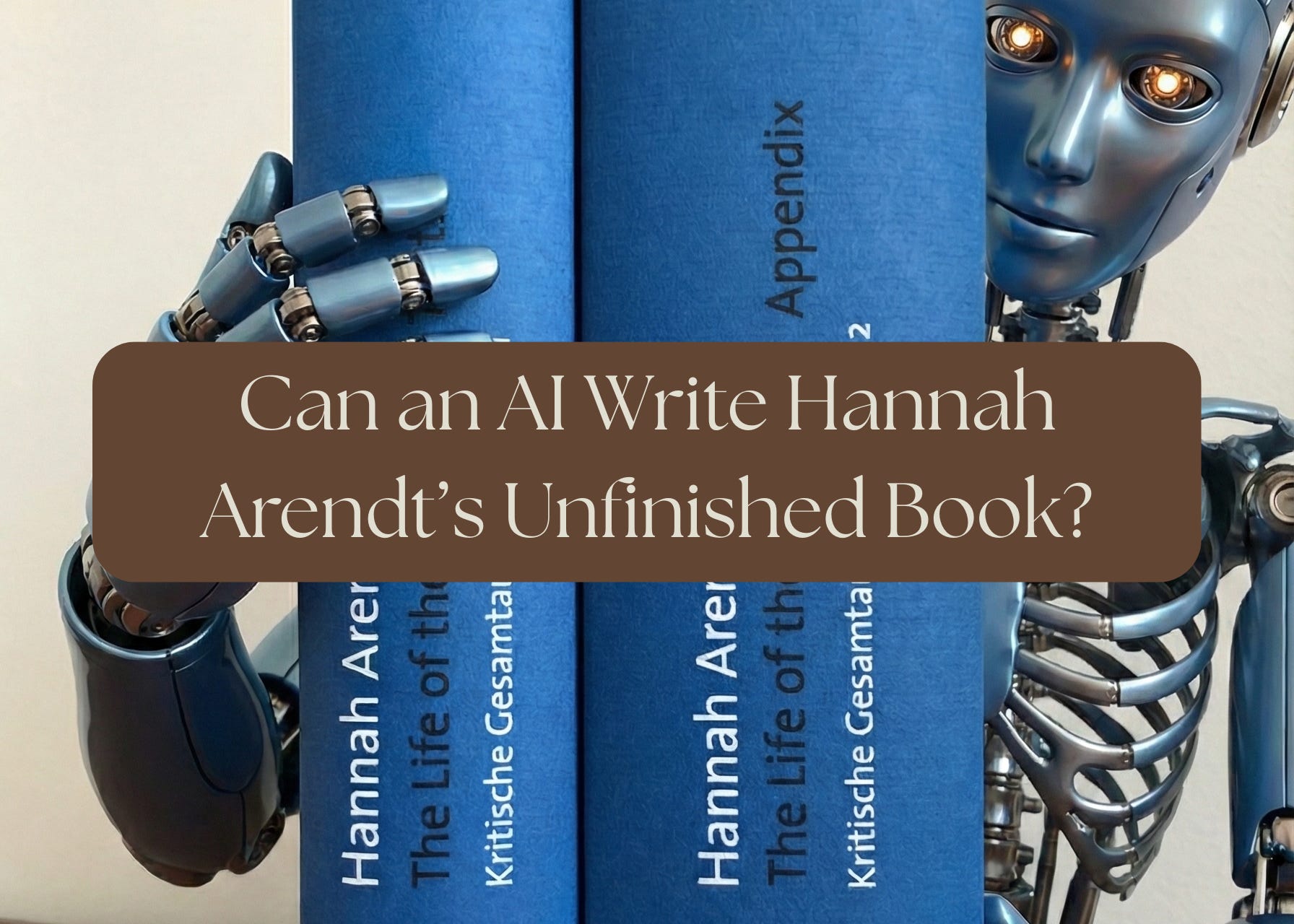
Fifteen years ago, I tried to predict a book that Hannah Arendt never wrote.
It was 2009. I was finishing my dissertation on Arendt’s theory of judgment, and in the final chapter I did something that felt audacious at the time: I attempted to reconstruct the unwritten third volume of The Life of the Mind, the book Arendt titled Judging, for which only a title page and two epigraphs survive.
I had spent a year in the archives at the Library of Congress, going through materials that were then only available in person. The Kant lectures on aesthetic judgment. Early manuscripts. Lecture notes. Correspondence. Everything she’d written in Thinking and Willing. The philosophical commitments threading through her published work. I looked for patterns, traced conceptual threads, tried to see where the logic pointed. My reconstruction argued she would have written something Augustinian rather than Kantian: interior dialogue meeting worldly care, judgment as amor mundi rather than aesthetic spectatorship.

I thought I’d solved the puzzle.
Now, in 2025, I could hand the same problem to ChatGPT or Claude.
Feed it the Denktagebuch notebooks (her philosophical diary from 1950-1973). Add the new critical edition of The Life of the Mind (volume 14 of the Hannah Arendt: Kritische Gesamtausgabe), prepared from her actual typescripts rather than Mary McCarthy’s 1978 posthumous edition. Add the rest of the ongoing critical edition, the digitized Library of Congress papers, and the major secondary literature from the past fifteen years. Then ask: What would Judging have said?
The technology makes the thought experiment concrete. But more importantly, the question has become genuinely interesting in a way it wasn’t in 2009. Because we now know three things I didn’t know then:
The 2024 critical edition of The Life of the Mind shows definitively what Arendt actually left. For Thinking and Willing we can track overlapping drafts and revisions. For Judging we now know there is nothing beyond the title page and the two epigraphs.
Fifteen years of archival scholarship has systematically dismantled the old Kantian consensus about what the book would have been, without replacing it with any new orthodoxy. My Augustinian reading has moved from heresy to “philosophically serious minority view.”
We could actually test this. Not just speculate, but run the experiment—and run it backwards first to see whether an LLM could predict the books she did write from what came before.
Should we?
What I Argued in 2009
The dominant interpretation at the time, crystallized by Ronald Beiner who edited Arendt’s posthumous Kant lectures, held that she had shifted late in life toward a Kantian spectator theory. On this reading, judgment was aesthetic, retrospective, and fundamentally detached: the work of cultured observers reflecting on political events from a distance.
I argued this was wrong. Arendt’s 1929 dissertation on Augustine developed a phenomenology of love that led to amor mundi, an explanation for why a Christian should love the world rather than seek heaven soonest. That concept, I thought, was the key to understanding judgment: not aesthetic contemplation but worldly care. Judgment meant sustaining a common world with others through ongoing interpretation and response.
This pointed toward deliberative democracy as Arendt’s political ideal. Judgment wasn’t a faculty you possessed or a skill you mastered; it was a practice you enacted with others. Taking up multiple perspectives, persuading without coercing, building agreements that didn’t erase plurality. The sensus communis wasn’t Kant’s transcendental ground but an achievement of communities that judge together.
It felt like the pieces fit. The Augustinian natality. The phenomenological emphasis on plurality and appearance. The resistance to both Kantian transcendentalism and Aristotelian virtue ethics. I thought I’d found the conceptual architecture she would have built.
In hindsight, what I was really trying to show was that Arendt’s originally Augustinian concern, how to love the world in spite of it, would have quietly organized the missing third volume.
What Changed Between 2009 and 2025
A lot, and it started almost immediately.
Months after I defended my dissertation, David Marshall published an article in Political Theory that formalized what I’d been arguing: using Arendt’s Denktagebuch (her philosophical notebooks from 1950-1973), he showed she’d been working on judgment continuously, not in the contradictory phases Beiner’s framework required. The notebooks had been published in German in 2002, but Marshall was among the first to use them systematically against the Kantian consensus.
That was 2010. The cracks widened from there. Shmuel Lederman argued in 2016 that there never was an “actor theory” to begin with: the entire two-phase framework was a scholarly construction. Linda Zerilli’s 2016 book A Democratic Theory of Judgment repositioned the question entirely, arguing judgment creates the public realm rather than merely evaluating it.
By 2024, the field had moved to what one recent survey calls “productive pluralism”: multiple sophisticated readings coexisting, with no new orthodoxy. My Augustinian reading, considered heretical in 2009, is now described in the literature as a “philosophically serious minority view.”
Then came the critical edition.
In 2024, The Life of the Mind was published as volume 14 of the Hannah Arendt: Kritische Gesamtausgabe. For the first time we see Thinking and Willing in a form based directly on Arendt’s typescripts, side by side with a digital apparatus that shows the layers of revision.
And for Judging, the news is stark: when Arendt died in December 1975, she had written exactly two things for the third volume. A title page with “Judging” typed at the top. And two epigraphs, one from Lucan about Cato siding with the vanquished cause, one from Goethe’s Faust about stripping away enchanted spells to stand as a man alone.
That’s it. No outline. No draft chapters. Not even fragmentary notes clearly intended for the volume.
For decades, scholars had treated the Kant lectures (delivered in 1970, edited posthumously by Ronald Beiner) as if they were a proto-draft of Judging. Beiner’s influential interpretation held that Arendt had shifted from an “actor theory” (judgment as practical wisdom) to a “spectator theory” (judgment as Kantian aesthetic reflection). That framework organized the field for thirty years, until Marshall, Lederman, Zerilli, and others dismantled it piece by piece.
One of the editors involved in the new critical edition of The Life of the Mind, Wout Cornelissen, has just published a long article in Arendt Studies that’s the best short guide to what the new edition changes. He argues that the project is not a quasi-Cartesian treatise on “the mind” but an inquiry into three free mental activities (thinking, willing, judging) that are basic, autonomous, and politically important precisely because they never add up to a final ground.
Cornelissen stresses two things that matter for my AI thought experiment. First, editors and scholars should resist the temptation to “complete” the book from the outside. The gap where Judging should be is part of what The Life of the Mind is about. Second, the restored final sentence of Willing (”this impasse... cannot be opened or solved except by an appeal to another mental faculty... the faculty of Judgment, an analysis of which at least may tell us what is involved in our pleasures and displeasures”) links judgment not to transcendental law-giving but to how we find ourselves affected by freedom, torn between being “pleased” with it and longing to escape its burden.
He also shows what McCarthy’s editing actually did. She made changes “in almost every line,” not just copyediting but interventions that changed the kind of text it appeared to be.
One example: Arendt translated Valéry’s “Tantôt je pense et tantôt je suis” as “Now I am, and now I think,” switching the verb positions and using “now” to bring readers into the immediacy of the experience. McCarthy changed it to “At times I think, and at times I am,” making it sound like an observation from outside rather than an experience from within.
In a crucial passage about Augustine and the will transformed into love, McCarthy added “To summarize:” at the beginning, framing Arendt’s thinking-with-Augustine as a conclusion rather than a movement. In the final paragraph about natality, McCarthy cut the clause “In other words, men are equipped for the seemingly paradoxical task of making a new beginning because they themselves are new beginnings and hence beginners,” apparently finding it repetitive. But Arendt explicitly calls beginning a “seemingly paradoxical task” in that sentence. The “repetition” was the point.
Cornelissen argues that the critical edition lets us experience Arendt’s “pondering reflection” as thinking in motion, not as a series of claims to be evaluated but as an invitation to think along with her. McCarthy’s edition, however unintentionally, converted that movement into propositional content.
And crucially: the critical edition deliberately separates The Life of the Mind from the Kant lectures again. When the book is presented without McCarthy’s appendiceal nudge, the Kantian reconstruction stops looking like a textual fact and starts looking like what it always was: one powerful, now contested interpretation.
So compared to 2009, we have two new constraints: (1) we know exactly how little text Arendt left for Judging, and (2) the editor of the critical edition is explicitly telling us that the book’s unfinishedness is philosophically meaningful, not just a biographical accident.
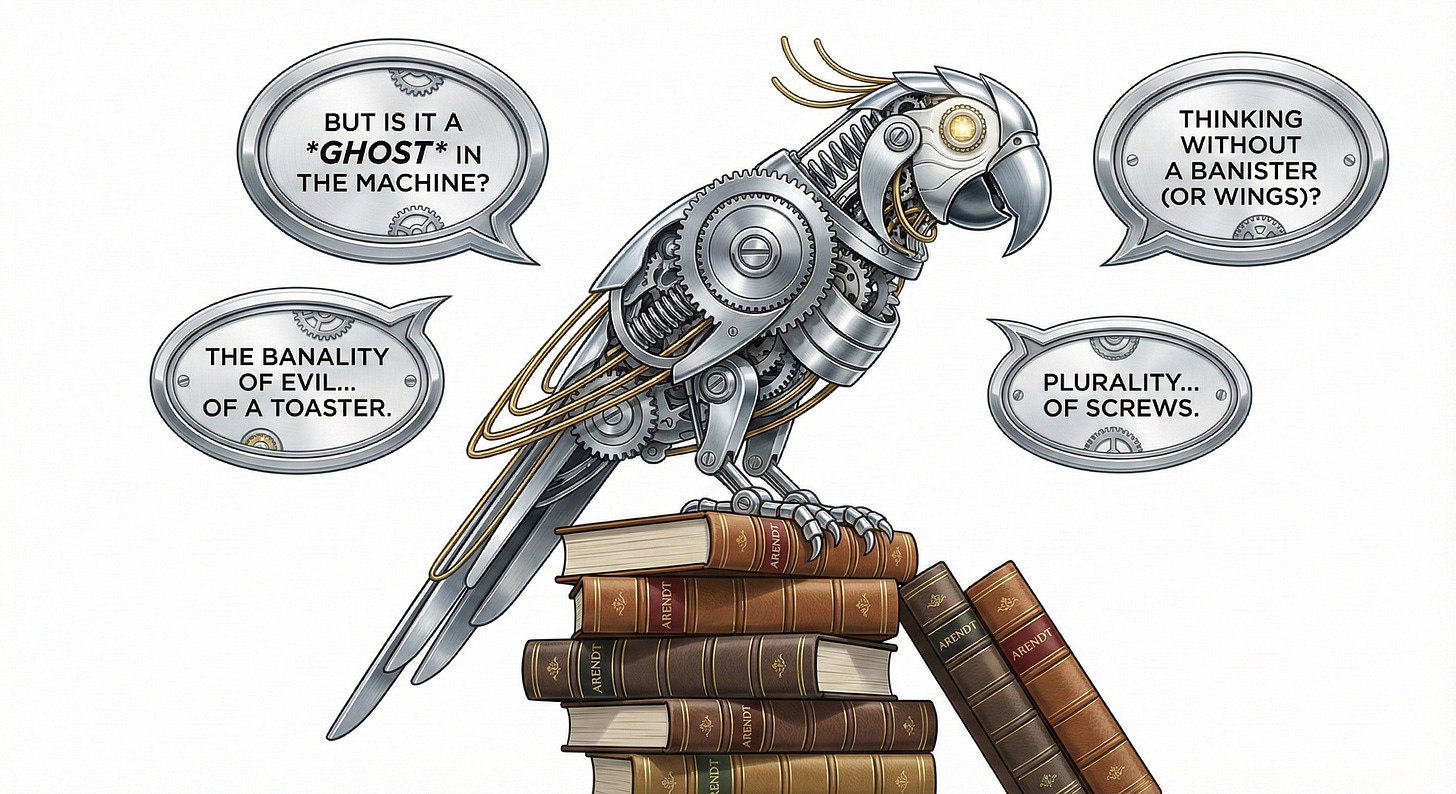
And then there’s the third change: we now live in a world where you can ask a “stochastic parrot” (Emily Bender’s term for large language models that remix patterns in text without understanding) to finish someone else’s book.
The Test (And What I’ve Already Learned)
I started running this experiment myself. Not the full institutional version (I don’t have the resources for that), but a preliminary test to see what would happen.
I fed ChatGPT the second volume of The Life of the Mind (Willing), along with some of the major secondary literature and portions of my own dissertation. Then I asked: what would Judging need to address?
ChatGPT did something sophisticated. It correctly identified the final paragraph of Willing as the key textual anchor, the passage where Arendt says we’re “doomed to be free” and that “this impasse cannot be opened or solved except by an appeal to another mental faculty... the faculty of Judgment.” It understood judgment as retrospective meaning-making rather than sovereign willing. It recognized the Augustinian-Nietzschean tension between natality and irreversibility. And it made a sharp meta-observation: “Judgment is the faculty that makes meaning out of the world’s givenness. Prediction is the faculty that anticipates meaning before it appears. They are not the same.”
That’s... not bad. It’s doing real interpretive work, not just summarizing.
But here’s what it produced: a Kantian reading. Reflective judgment, aesthetic-affective response, communicability through sensus communis, the problem of how particular judgments can claim validity without rules. In other words, it predicted the Beiner consensus, the interpretation that dominated from 1982 to 2010 and that fifteen years of scholarship has been systematically dismantling.
At first I thought: well, of course. The LLM is just extrapolating from patterns in the text, and the Kantian reading is the most obvious extrapolation. Maybe that tells us something about why that consensus formed in the first place.
But then I realized something else. ChatGPT wasn’t just reading Arendt’s texts. It was reading Mary McCarthy’s 1978 edition of The Life of the Mind, the edition that includes the Kant lectures as an appendix. McCarthy made an editorial decision about what Judging would have been by positioning those lectures at the back of the book. She didn’t say “this is the third volume,” but the gesture invites readers to treat them as the obvious next step.
The LLM didn’t independently discover the Kantian reading. It followed the interpretive frame already embedded in the standard edition. And McCarthy’s sentence-level editing, converting Arendt’s “movement of thought” into propositional conclusions, made it easier to read the work as heading toward a Kantian synthesis.
Which means my preliminary test revealed something, just not what I expected. It showed how much posthumous editorial decisions shape what we think authors “would have written.” The prediction wasn’t discovering Arendt’s intentions; it was reproducing the textual container we inherited.
So here’s the proper test:
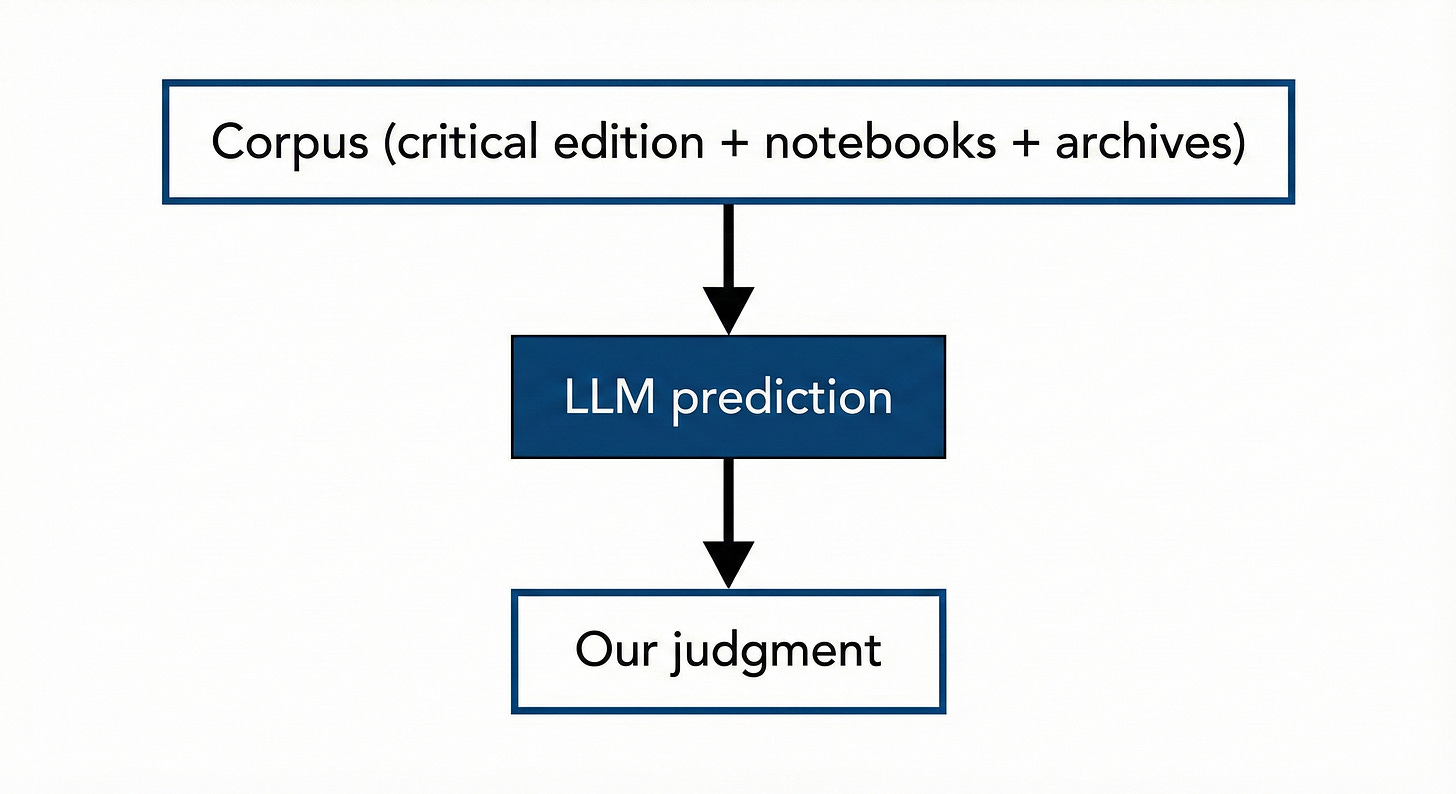
My back-of-the-envelope experiment relied on the wrong edition. A proper test would build the corpus from the critical edition, the one Cornelissen and his colleagues just produced.
You’d want at least:
The Life of the Mind: Texte/Texts (volume 14 of the Kritische Gesamtausgabe), including the critical notes that show how Thinking and Willing were actually composed
The Denktagebuch notebooks (1950-1973)
The digitized Library of Congress materials (lecture notes, drafts, correspondence)
Major secondary literature from the past fifteen years, weighted so that older Kantian readings don’t simply dominate by volume
Feed this to multiple LLMs: ChatGPT, Claude, Gemini, maybe Mistral or whatever else is available. Compare outputs.
Then run the backwards test first:
Given everything Arendt wrote before volume 1 (Thinking), can the models predict the themes, structure, and argument of that book?
Given everything before volume 2 (Willing), can they predict that one?
This isn’t just a control; it’s the real question. If the models can’t predict the books she actually wrote from what came before, that tells us her “interruptions” (the pivots from Human Condition to Eichmann, from political theory to the life of the mind) were genuine departures, not extensions of existing patterns. If they can predict those books... well, that’s fascinating too. Maybe natality shows up in patterns we didn’t recognize.
Use those results as context for the final experiment: predict the outline, themes, and content of volume 3.
I can’t do this alone. I don’t have institutional access to run systematic comparisons on a corpus this size. I don’t have the time; I’m working full-time on juvenile justice reform. And I hit technical limitations: when I tried to feed Claude the full Life of the Mind PDF, it broke. Too big.
But the question remains genuinely interesting: not just “can AI write like Arendt?” but “what does predictability tell us about interruption, natality, and the nature of judgment itself?”
What We Learn Either Way
The interesting thing about this test is that both outcomes tell us something worth knowing.
If the LLMs successfully predict Thinking and Willing from what came before, that’s fascinating. It would mean Arendt’s “interruptions” (the pivot from The Human Condition to Eichmann in Jerusalem, from political theory to the life of the mind) were more patterned than they feel from inside the work. Natality might show up in predictable ways. The “capacity to begin” might itself follow patterns we can trace but didn’t recognize until machines made them visible.
That wouldn’t make her work less original. It would reveal something about how originality actually works: not as random rupture but as transformation of existing materials in ways that feel unprecedented but follow recognizable patterns once you map them. Which is, in a way, already an Augustinian thought: we are “new beginnings” born into a world we didn’t make.
If the LLMs fail to predict those books, that would be one way of making vivid what Cornelissen means when he calls thinking, willing, and judging “free mental activities”: basic, but not capturable as stable patterns. Something about the way Arendt thinks would resist the pattern-completion that LLMs do so well. And then we’d want to know: what resists? Where does prediction break down?
Either way, we learn something about the relationship between prediction and interruption, pattern and beginning.
For the Judging prediction specifically, the possibilities are more baroque:
A Kantian output would show how strongly McCarthy’s editorial framing and Beiner’s framework still shape the textual field, even after the critical edition.
An Augustinian or world-disclosure reconstruction would show that the newer scholarship and the critical edition have started to reweight the corpus in genuinely different ways.
A genuinely unexpected fourth option would be most interesting of all, not because it would reveal Arendt’s intentions but because it might surface patterns in the corpus that human interpreters missed while pursuing their theoretical commitments.
And whatever comes out, Cornelissen’s caution stands: we should not let any of these reconstructions harden into the real third volume. The point would be to explore the space of possibilities, not to close it.
AI, Judgment, and Standing in the World
What does any of this tell us about AI and judgment?
Not that “LLMs can’t judge” and humans can. That’s too quick and too flattering to us. My preliminary experiment already showed that a model can track a tricky line of argument across volumes, identify the right textual hinge, and offer a perfectly respectable reconstruction, even if it defaults to an older consensus.
But judgment, on my reading (and on Cornelissen’s), is something different. Not because it’s mystical, but because it is:
World-bound: it starts from what appears between us
Plural: it takes other standpoints into account
Risk-bearing: it is exposed to disagreement and correction
Non-final: it never achieves the “last word” we secretly want
LLMs don’t have a world in that sense. They don’t occupy a position among others; they don’t risk anything; they don’t inherit or pass on responsibility. They complete patterns in language. That can assist judgment, provoke it, sharpen it, confuse it, but it isn’t the same activity.
Running a Judging experiment with LLMs, then, wouldn’t be a way to bypass human judgment. It would be a way to stage the difference between pattern completion and world-oriented meaning-making—to see, almost under laboratory conditions, where prediction runs out and the need for judgment begins.
And What It Tells Us About Scholarship
For me, the most uncomfortable lesson so far has been about my own field.
When ChatGPT reproduced the Kantian consensus, it was simply performing what the standard edition and its editorial apparatus had encoded. McCarthy’s decision to append the Kant lectures to The Life of the Mind was never neutral curation; it was an interpretive act that effectively told generations of readers: this is where she was heading. Beiner’s reconstruction then rode on top of that editorial framing and became invisible as a choice because it matched the way the book had been packaged.
Cornelissen’s critical edition, and his article, gently but firmly undo that packaging. They insist on showing us exactly what Arendt wrote—and where she stopped. They ask us to take the missing volume seriously as a philosophical fact, not a mere archival annoyance.
The AI experiment I’m proposing would, in its own way, do something similar. By forcing us to specify what goes into the corpus, how we weight different editions, which articles we treat as central, it would make explicit what has mostly been implicit: the scaffolding of interpretive decisions behind every “natural” reading.
That’s useful even if you hate everything about AI.
Is This Sacrilege?
If your first reaction to this proposal is discomfort, I share it. There is something unsettling, maybe even profane, about asking a stochastic parrot to “finish” the book Arendt died before she could write.
For some Arendt scholars, this will feel like a category mistake: treating a thinker who spent her life warning against the substitution of process for judgment as one more benchmark for predictive text. For others, it will feel like a failure of piety toward the archive: why feed 24 volumes of painstaking critical work into a system that can’t even appear in the world, much less take responsibility for a reading?
I don’t want to smooth those objections away. Part of what makes this experiment interesting is precisely that it tests a boundary: between honoring a thinker and instrumentalizing her, between treating the unwritten volume as an open philosophical problem and treating it as a hole to be patched by computation.
My own view is that the line gets drawn, not at “never run the experiment,” but at what we let it mean. If we treat any model output as the lost third volume, that’s sacrilege in the worst sense: replacing judgment with pattern, and doing it in Arendt’s name. If we treat the outputs as a way of making our own editorial frames and scholarly habits visible, as one more occasion for judgment rather than a shortcut past it, then even the discomfort becomes philosophically productive. The controversy is not a bug; it’s part of what the experiment is meant to expose.
So: Who Wants to Do This?
Here’s what I’m proposing to Anthropic, OpenAI, Google, or whoever wants to try this:
Run the test. Use the critical edition, the Denktagebuch, the archival materials, the post-2010 scholarship. Build the corpus properly. Run the backwards validation first—see if you can predict Thinking and Willing from what came before.
Then predict Judging. See what you get.
And treat whatever you get as what it is: not Arendt’s last word, but a mirror held up to our own editorial frames, scholarly habits, and philosophical hopes.
Fifteen years ago, I tried to reconstruct Judging with a year in the archives, a stack of photocopies, and a very earnest faith in my own interpretive judgment. Now we can try it again with GPUs and stochastic parrots and a much clearer view of what Arendt actually left us—and what she didn’t.
I don’t think an AI can write Arendt’s unwritten book. What it can help us see is not her last word, but our own habits as inheritors: where we lean on familiar patterns, where we’re a little too eager to let prediction stand in for judgment, and how much of a life’s work still resists being reduced to a pattern.
And has to be taken up again as an unfinished beginning.
Wout Cornelissen’s article on the critical edition, which informed several arguments in this post, is: “Switching Perspectives: Reading Arendt’s The Life of the Mind Anew,” Arendt Studies 9 (2025): 21-49. doi:10.5840/arendtstudies202594