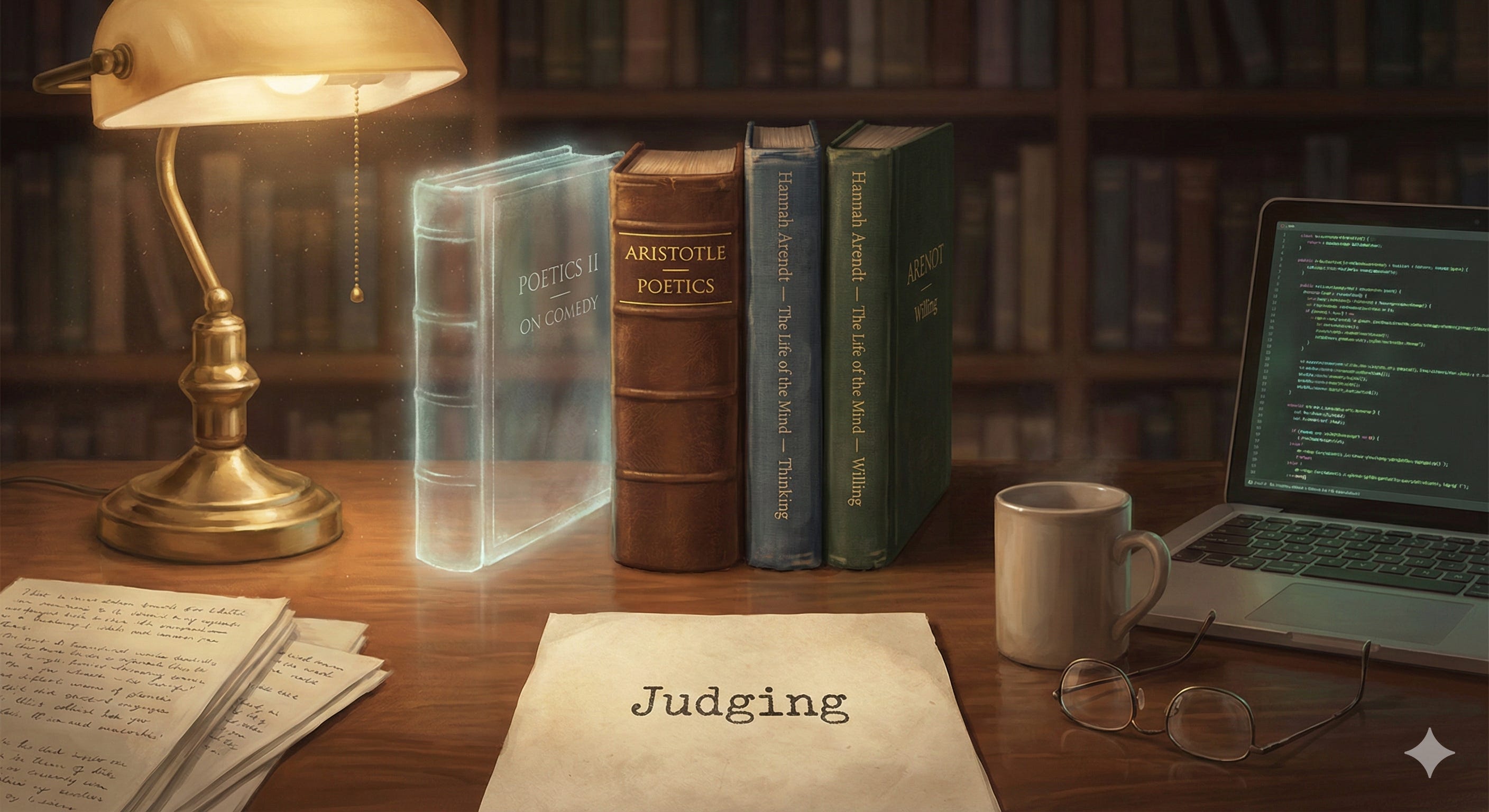
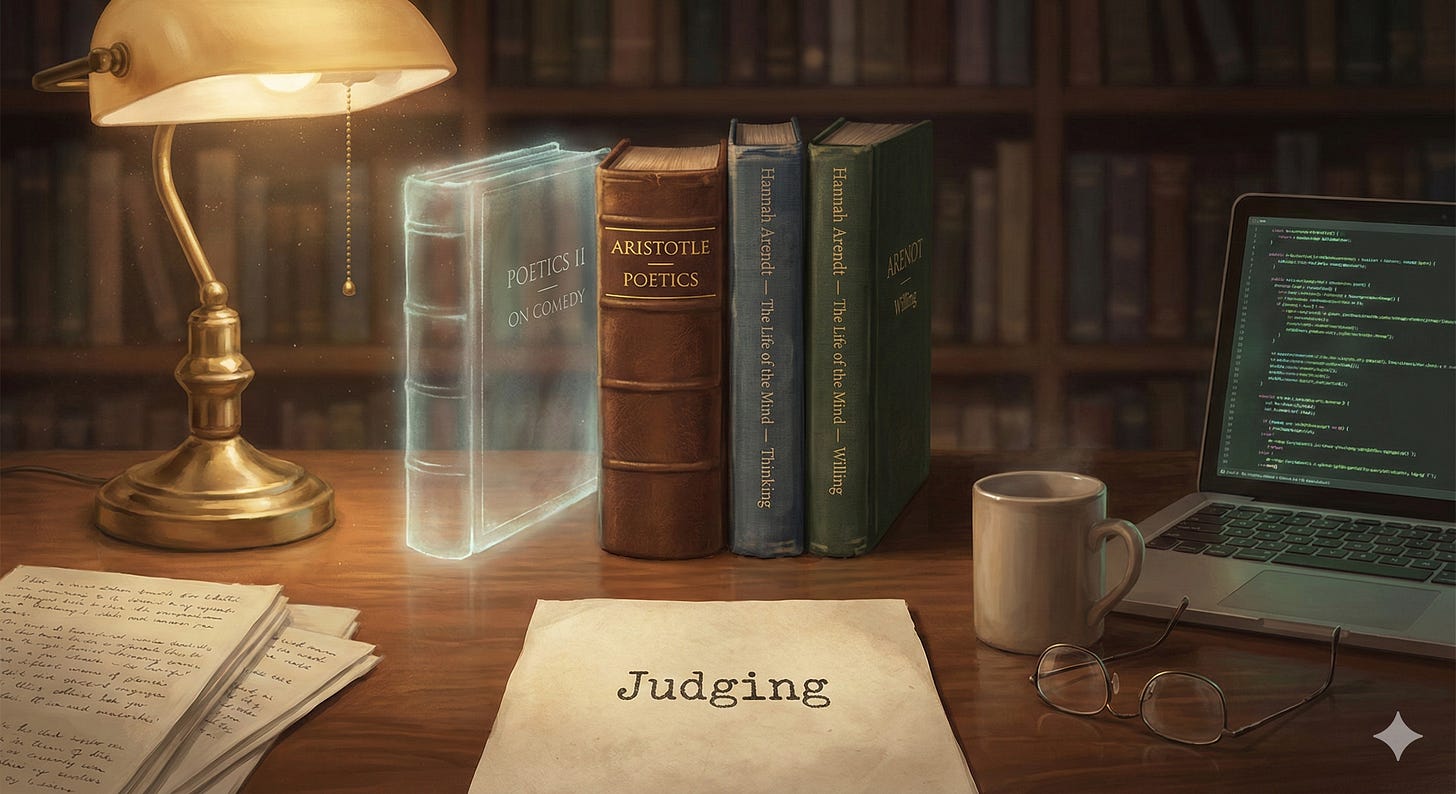
Aristotle’s Poetics presents itself as an account of tragedy and comedy. What survives is overwhelmingly the tragedy half.
For centuries, readers have treated the lost “book on comedy” as a philosophical MacGuffin: the missing key that would finally explain laughter, embodiment, and the politics of ridicule. Umberto Eco built a whole novel around the idea that this text was hidden, suppressed, dangerous. Scholars have proposed reconstructions. Graduate students still write dissertations trying to reverse-engineer what Aristotle “must have said.”
Whether Aristotle actually wrote a full “comedy” sequel is less important than how the idea of one has functioned. The gap isn’t evidence of a secret doctrine. It’s a projection surface. We smuggle our own hopes for comedy into the unwritten text and then cite “Aristotle” as the ghostly author.
Missing books rarely preserve wisdom. They create an opportunity: to treat absence as authorization. The pattern is simple. Step one: invoke the missing volume as if it contains a determinate doctrine. Step two: treat your preferred doctrine as that doctrine. Step three: cite the dead author to bypass the burden of argument.
Arendt’s Judging Is Our Poetics II
Hannah Arendt died suddenly in December 1975, collapsing during an evening with friends. She left two completed volumes of The Life of the Mind (Thinking and Willing) and a title page for Judging with two epigraphs beneath it. That was the entire manuscript: a title and two quotations. The cause of the gap is ordinary and final: she died.
No draft. No outline. No notes that can be confidently assigned to Judging: the rest is inference. The post-2010 publication of her notebooks and the 2024 critical edition of The Life of the Mind, which presents her actual typescripts for the first time, confirm she had barely begun the third volume. Subsequent scholars dismantled Beiner’s framework, but no new consensus replaced it. The field fractured into what one survey calls “productive pluralism”: multiple sophisticated interpretations, none dominant, all projecting onto the same gap.
And yet: people keep writing as if Judging exists in potentia, as if Arendt’s unfinished project contains, in ghostly form, the theory we need. “Arendt’s account of judgment shows us…” “The third volume would have argued…” “If only she had lived to complete it…”
The canonical example is Ronald Beiner’s influential decision to publish the 1970 Kant lectures as a de facto third volume, a move that shaped a generation of Arendt readers into thinking Judging would have been a Kantian spectator treatise. Maybe it would have. But the notebooks don’t support that confidence.
The move is always the same: treat the gap as a promissory note, then cash it for whatever you need. I’ve done this myself. My own dissertation tried to reconstruct what Judging “would have” argued, and later scholarship showed how much of that was projection dressed up as exegesis.
Why This Gap Got Supercharged in 2025
Two things have made the Judging fantasy newly urgent.
The first is that we can now operationalize it. The critical edition raises the question anew, and the fiftieth anniversary of Arendt’s death makes it feel salient. I recently proposed an experiment using large language models: feed them Arendt’s published work and ask them to “complete” Judging. Even an incomplete version generated interesting results: coherent, plausible, and completely fabricated. Pattern-completion masquerading as reconstruction. What struck me wasn’t that the LLMs failed to capture Arendt. It’s that they made literal a move scholars are always tempted by: turning absence into permission.
The second is that we desperately want a theory of judgment that can resist the “imperialism of instrumental reason”—a phrase I’m borrowing from Luke Fernandez’s sharp article in Critical AI on Joseph Weizenbaum, the builder of the ELIZA chatbot who spent his later career warning that computational thinking would hollow out our capacity to judge. He frames his argument with a memorable mayoral race in Cheyenne, Wyoming, where a candidate campaigned on the promise to outsource all governing decisions to an AI system modeled after ChatGPT. He’d handle the ribbon cuttings; the chatbot would run the city. Commentators immediately recognized the problem: is this democracy, or a decision pipeline effectively governed by a handful of tech executives? And more fundamentally: is judgment something we can delegate at all?
Fernandez tracks how Weizenbaum saw this coming in the 1970s: the temptation to treat political conflicts as “information problems,” moral decisions as optimization tasks, and human beings as “meat machines” whose only value is performance.
That temptation has only intensified. The impulse to reach for Judging is understandable: we want a vocabulary for responsibility that isn’t just optimization. And so we reach for Arendt’s missing book as a theoretical prosthetic—a ghost text that might anchor “the human” against computational flattening. A contingent absence gets upgraded into a fantasy of the salvific book that would secure judgment against both bureaucracy and machines.
But a ghost text can’t anchor judgment. It can only borrow Arendt’s authority for someone else’s framework.
It’s worth asking, too, whether our fixation on Arendt’s unwritten Judging is a tell… especially now, when the AI “answer-machines” are everywhere. Arendt’s most influential diagnosis isn’t a failure of judgment in the abstract, it’s thoughtlessness: the ease with which clichés replace thinking, and obedience dresses itself up as innocence. Maybe what we want from the missing volume is precisely what Arendt trained us not to want: a device that outputs the right verdict so we don’t have to do the harder work of thinking what we are doing.
Three Things People Smuggle into Judging
Here’s what gets projected onto the gap. Each is a real strand in Arendt’s work. The distortion begins when any strand is treated as the missing volume’s settled content—when “could” quietly becomes “would.”
A Kantian spectator manual. Arendt loved Kant’s Critique of Judgment—selectively. She lifted sensus communis (common sense) and “enlarged mentality” (the capacity to think from the standpoint of others). Some readers treat this as a technique: if you can imaginatively inhabit enough perspectives, you’ll judge well. But Arendt ignored Kant’s transcendental machinery and refused to subordinate politics to moral law. A full Kantian spectator theory would drag her back into the metaphysics she’d spent her career escaping.
A deliberation handbook. If you’re hoping Judging would have resembled Rawls or Habermas—a theory of public justification, procedural norms for legitimate discourse—Arendt would disappoint you. She was deeply suspicious of proceduralism. Judgment, for her, is not what happens after we’ve agreed on the right method. It’s what we do precisely when method fails.
A phronesis guide. Some readers project Aristotelian practical wisdom onto the gap: Judging as a manual for reading situations, anticipating consequences, acting well under uncertainty. This fits Arendt’s love of political courage. But it runs into the end of Willing, where she suggests that judgment is something other than willing—oriented toward a shared world, not the inner struggle of the self with its own choices. She didn’t want judgment to be a virtue of heroes. She wanted it to be a practice of citizens. And practical wisdom can still be excellent at optimizing within a bad frame.
Linda Zerilli’s A Democratic Theory of Judgment (2016) offers the sharpest corrective: judgment as world-building practice rather than rule-following—but even that doesn’t settle what the missing volume would have said. The gap remains.
This brings us back to the Cheyenne mayoral race—and to the larger question of what we want when we invoke Arendt against AI: not better predictions, but fewer alibis.
When people say “AI threatens human judgment,” they often mean something like this: we want a sphere of decision-making that cannot be outsourced; we want politics not to become a branch of optimization. So we reach for Arendt’s unwritten Judging as if it might supply a philosophical guarantee: something that could anchor “the human” against computational flattening.
But Arendt doesn’t offer guarantees. She treats judgment as precarious: plural, worldly, and always at risk. The danger isn’t the machine; it’s the temptation to abdicate, to let a system, a cliché, an ideology, or an expert do our judging for us.
Her emblematic case wasn’t an algorithm. It was Adolf Eichmann: a bureaucrat who treated obedience as innocence, who substituted stock phrases for thought, and who refused to judge beyond the categories his system handed him. The problem is not that machines are inhuman. The problem is that we become thoughtless—and then build, deploy, and obey systems that make it easier to stay that way.
What If Judgment Isn’t a Missing Technique?
The interpretation I find most compelling draws heavily on Linda Zerilli’s A Democratic Theory of Judgment: judgment isn’t a faculty we possess, a method we apply, or a skill we train. It’s the ongoing, collective activity by which we hold a common world together. Zerilli calls it “a democratic world-building practice.” Less adjudicative, more creative and reflective.
My own dissertation was trying to get at something adjacent through Augustine: not just that we build a world together, but that judgment is the disposition to love it. Amor mundi. The capacity to find the world worth caring about despite its brokenness, to embrace our thrownness rather than flee into abstraction. I didn’t land it cleanly, and Zerilli’s framing is sharper. But the convergence matters: multiple scholars, working from different sources, arriving at the same refusal to treat judgment as technique.
On this view, judgment operates across three registers at once. Retrospectively, deciding which stories will stand as true or exemplary. Synchronically, negotiating contested appearances in real time: Is this a protest or a riot? A whistleblower or a leaker? A surge in crime or a surge in reporting? Prospectively, shaping what feels possible next by deciding which precedents we carry forward.
The center of gravity moves away from heroic individuals and toward ordinary practices of sense-making: testimony and investigation, journalism and counter-journalism, the simple act of saying “this is intolerable” or “this must not be forgotten.”
But here’s the key point for our present anxieties: this view doesn’t give you a technique that resists AI. It gives you a description of a practice that AI can hollow out, mimic, or assist… depending on how we build our institutions. Forecasting assumes a fixed ontology (which outcomes to track, whose suffering to count, which variables matter). Judgment fights over that ontology. No amount of better prediction settles the question of what we should be predicting in the first place.
Stop Waiting for the Ghost Book
Missing books don’t save us. They excuse us.
Fernandez usefully foregrounds Weizenbaum’s insistence on “small contexts”—the everyday settings where judgment is hardest because the risks are petty and immediate: status, career, comfort. And Weizenbaum is blunt about the danger: the myth that the system is inevitable becomes a tranquilizer, a way of laundering responsibility.
That’s not a story about “computers.” It’s a story about alibis.
Ghost texts perform the same work in scholarship. If the dead already “said” it, you don’t have to risk saying it. If Arendt “would have argued,” you don’t have to argue. You get to borrow authority without paying the price of exposure.
That is how judgment decays: not when machines arrive, but when we accept the substitute, whether it comes from an algorithm, an institution, or an unwritten book.
Judging is not there to be cited. It is there to be done.
Ghost books can’t do the work of judgment. Only the living can.