Barbara Ehrenriech’s book Bright-sided starts with an interesting dilemma in breast cancer treatment. On the one hand, your odds of surviving–say–stage 4 breast cancer is quite low (22%). On the other hand, there is evidence that optimism and hopefulness will increase your chances. Being optimistic won’t increase your chances above 50%, but it will help….
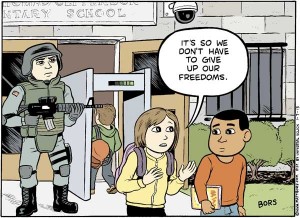
The New York Times has a story on the new CCRB report that includes data on the rise of proveable police deception: In New York, the number of false statements noted by the agency, while small, has grown in an age of easy and widespread video and audio recording by civilians. In 2014, the agency found…
One of the reasons I blog less than I used to is that in addition to running this journal I’ve been teaching and organizing a college program at Jessup Correctional Institution . (Although I think it was having a daughter that really sucked the wind out of my sails, blogging-wise.) Anyway, to prove I haven’t…
I’m not a libertarian, but some of my good friends are and I tend to think that there are lots of really promising areas of agreement with libertarians. The blog Bleeding Heart Libertarians was founded with just that goal in mind: to find the points of agreement between libertarian and progressive goals, and indeed (in…
What is meaning in life? A couple weeks ago we had a visit from David Benatar, who kindly shared a chapter from the new book he was writing. The chapter he shared was on meaning in life, and it was–as much standard analytic philosophy is–pretty narrowly focused on making distinctions and arguing against various perspectives….
A couple of years back Tim Scanlon did a blog post and comment-section discussion on PEA Soup . Here’s one bit: In earlier work, including my Tanner Lectures on the significance of choice and Chapter 6 of What We Owe to Each Other, I rejected the idea of moral desert because I identified it with…
The profile of Judith Clark from last month has me worried: We are more willing to impose death when the killer is painted in monochrome—if we can define him or her by the horror of the crime. Many think this is just; that is what blame and punishment are about. But in rare public comments…
Is the problem that philosophers and folks in the humanities think that genius exists, and it doesn’t? Or is the problem that philosophers and folks in the humanities think that they can detect genius, and–because of their racism and sexism–they can’t?
Futures Thinking: The Basics Asking The Question Scanning the World Mapping Possibilities (Part 1, Part 2) Writing Scenarios Three Possible Economic Scenarios (Part 1, Part 2) A Bibliography