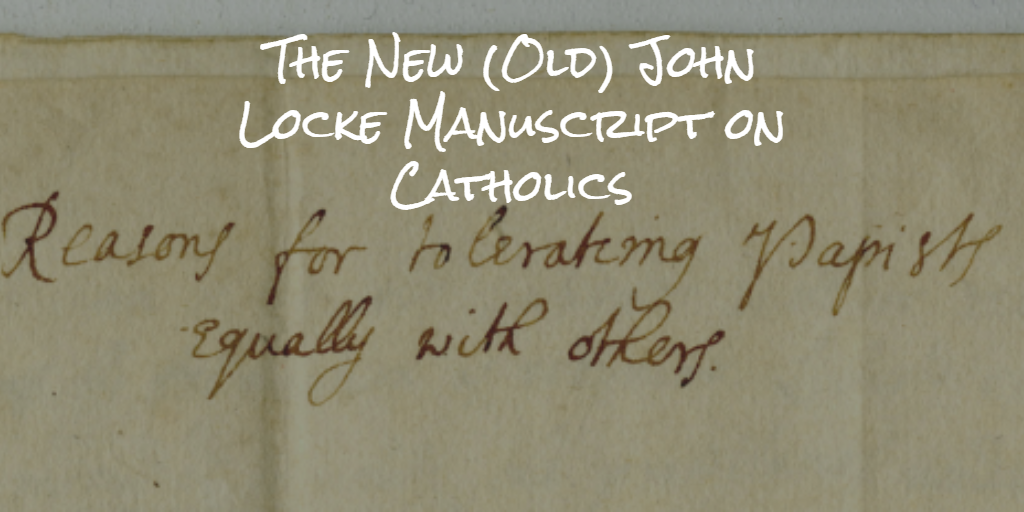
Reasons for Tolerating Papists Equally with Others I read about it in the Guardian yesterday, and my cousin at St. John’s found the digital copy right there on the internet in plain sight. Apparently no one had attempted to transcribe it yet? It’s a confusing document–looks like reading notes from some separate document, as there…
Following up their earlier study , John Jay College has produced an analysis of the sex abuse scandal in the US . I think it is mostly quite a good analysis, though there are a few weakness and one or two unnecessarily controversial claims tied to those weaknesses. To my mind, the most crucial section…
Part 1: Forgiveness and the Problem of Irreversibility Part 2: Forgiveness as a Manifestation of Divine Charity Part 3: A Duty to Forgive? Part 4: Prejudice as the Crystallization of Judgments Part 5: Charity as a Flight from Politics Part 6: Publicity without Politics Following Nietzsche, Arendt speaks of the Christian publicity without politics as world-destruction and ultimately as ‘desertification’: “the…
My focus in this project is to look at various institutions that try to track the truth about moral value, of which the Roman Catholic Church is only one. The Catholic Church is certainly wrong about consensual adult homosexuality, but what’s interesting is that this error is the result of a method of moral inquiry…
It’s been a few months since I promised a series of posts on the Catholic Church and epistemic institutional design, but I have been working on it. As the Pope marks the end of the aptly named “Year of the Priest” today , I thought I’d return to it. In this post, I will show…
The Catholic Church has been having a rough time of it lately . In a series of posts, I want to take up some of the implications of this trouble for epistemic institutional design, that is, for building institutions that ‘get it right.’ First, some background: what has previously been a primarily American problem of…
Sam Harris has started another great debate over religion, this time with conservative author Andrew Sullivan. They’ve been fairly civil with each other, and what little upset there has been has arisen from the justifiable claims they both make about the intellectual honesty of theism. In other debates, Harris has been too civil with his…
So in the last post, I showed how the initial versions of Christian judgment were remarkably modest and fallibilist with regard to other people. This makes a certain amount of sense, since Augustine was attached to a fairly rationalist theology, and always gave both doctrinal and basically ethical reasons for his judgments. (For instance, with…