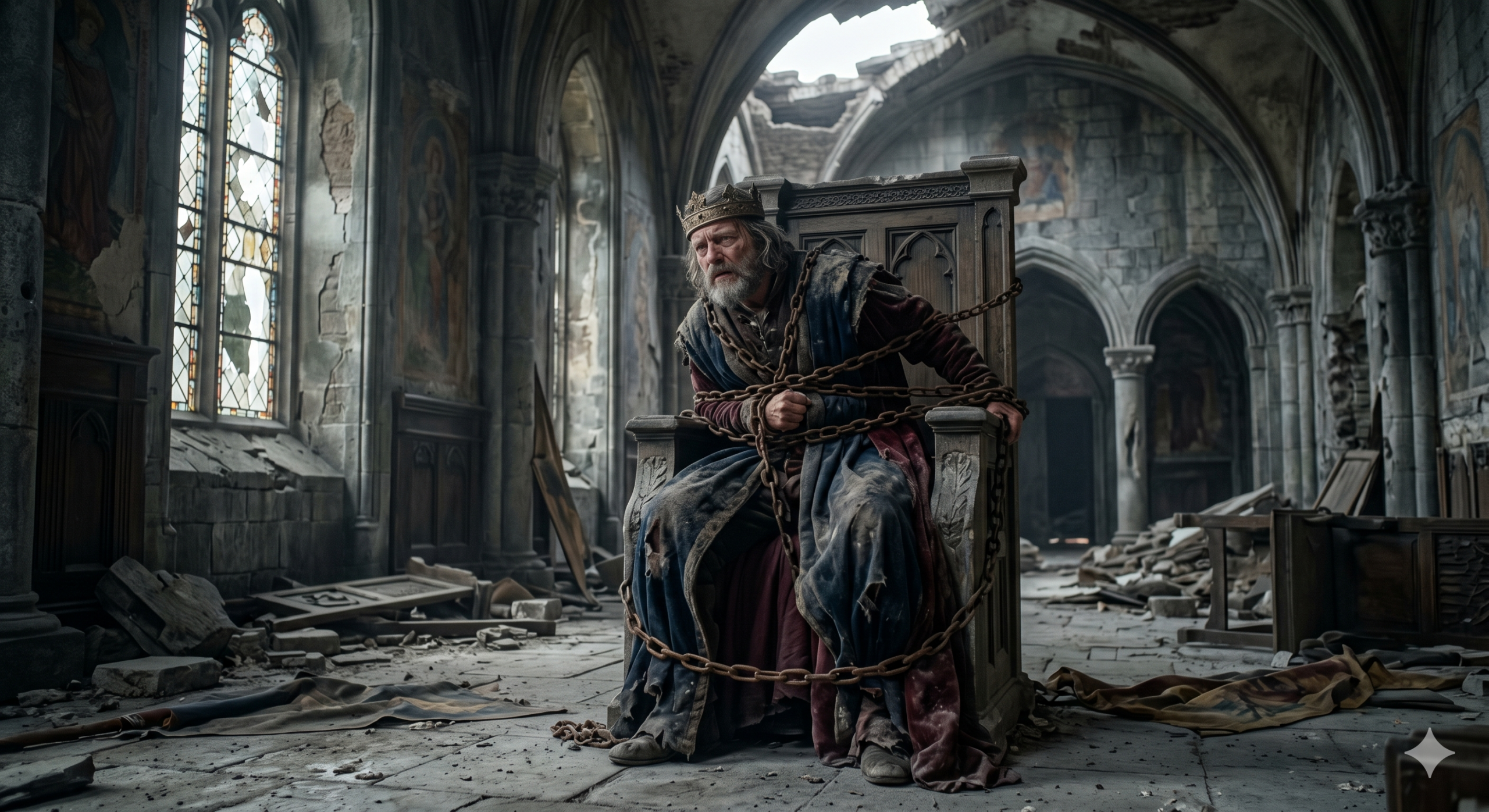
A sequel to the Orbán piece, which argued that the answer to a charismatic autocrat isn’t a better charismatic. Here’s the structural companion: why the American constitutional order keeps inviting caudillos, and why Congress, not the presidency, is where the repair has to happen.
A sequel to the Orbán piece, which argued that the answer to a charismatic autocrat isn’t a better charismatic. Here’s the structural companion: why the American constitutional order keeps inviting caudillos in the first place, and why Congress, not the presidency, is where the repair has to happen.
I like to think of myself as a legislative supremacist. When I ask which branch of the federal government has both the authority and the duty to run the country, I answer Congress. Not the presidency. Not the Supreme Court, which arrogated much of its own power to itself in Marbury v. Madison and has been reinterpreting its role ever since (that’s a fight for another post). Congress. The first branch named in the Constitution, vested with the lawmaking power, the power of the purse, the power to declare war, the power to impeach and remove, and the power to structure the federal courts and the executive departments. If the American system works, it works because Congress is doing its job. If it doesn’t work, it’s usually because Congress isn’t.
I like to think of myself as a legislative supremacist. What I mean by that is: when I ask which branch of the federal government has both the authority and the duty to run the country, I answer Congress. Not the presidency, and not the Supreme Court, which arrogated much of its own power to itself in Marbury v. Madison and has been reinterpreting its role ever since (that’s a fight for another post). Congress. The first branch named in the Constitution, vested with the lawmaking power, the power of the purse, the power to declare war, the power to impeach and remove, and the power to structure the federal courts and the executive departments. If the American system works, it works because Congress is doing its job. If it doesn’t work, it’s usually because Congress isn’t.
This is an unfashionable position. Americans have a cultural love affair with executive authority that runs from the Founders through CEOs, mayors, generals, and the presidency. We tell stories about presidents the way other peoples tell stories about kings. The whole shape of American civic imagination tilts executive-ward, and the taste keeps making the presidency bigger than the Constitution ever meant it to be.
This is an unfashionable position. Americans have a cultural love affair with executive authority that runs from the Founders through CEOs, mayors, generals, and the presidency. We like the idea of one person in charge. We like the drama of a single decision-maker. We tell stories about presidents the way other peoples tell stories about kings, and we get visibly confused when foreign parliamentary systems produce prime ministers whose personalities nobody can quite describe. The whole shape of American civic imagination tilts executive-ward.
Political science has something to say about this, and what it says is not reassuring.
The Linzian Nightmare
Juan Linz’s classic argument about presidentialism was devastating because it was so simple. In “The Perils of Presidentialism” (1990), he argued that two different institutions in a presidential system claim democratic legitimacy at the same time. The legislature represents localities and factions. The president claims to represent the nation. When they deadlock, there is no internal mechanism to resolve the dispute. In a parliamentary system, a government that loses legislative confidence falls. In a presidential system, the president and the legislature stare at each other across a constitutional gulf, each claiming to speak for the people.
The Yale political scientist Juan Linz is still not well-enough known, despite the fact that he gave an unusually clean account of a pathology most people can feel but few pundits can name. In “The Perils of Presidentialism” (1990), Linz argued that presidential democracies break down at alarming rates, and that the reason is structural rather than cultural. In a presidential system you have two independently elected bodies claiming democratic legitimacy (a legislature representing distinct localities and an executive representing the national electorate) and no principled way to adjudicate between them when they deadlock. Parliamentary systems have a solution: if the government loses the confidence of the legislature, the government falls. Presidential systems don’t. The president and the Congress stare at each other across a constitutional gulf, each insisting on their own mandate, and eventually one of them reaches for extra-constitutional tools.
Bruce Ackerman gave this breakdown its best name: the “Linzian nightmare”. One branch eventually tries to destroy the other and install itself as the real lawmaker. Latin America offered the textbook cases. Liberal reformers borrowed Montesquieu and the Federalist, wrote charters with bicameral legislatures and strong elected executives, and then watched frustrated presidents break the system open and remake themselves as plebiscitary rulers. For a long time Americans treated that as somebody else’s pathology. It isn’t. It’s ours. We are running the same pattern through the same mechanism, just later and with better furniture.
I first came across Linz through Bruce Ackerman’s “The New Separation of Powers”, where Ackerman gives it a name:
In an effort to destroy its competitor, one or another power assaults the constitutional system and installs itself as the single lawmaker, with or without the redeeming grace of a supportive plebiscite. I call this breakdown the “Linzian nightmare” in ironic tribute to my friend and colleague Juan Linz.
Ackerman’s gloss is that the separation of powers has been one of America’s most dangerous exports. Latin American liberals read Montesquieu and the Federalist, wrote constitutions with bicameral legislatures and strong elected executives, and then watched those constitutions get exploded by frustrated presidents who disbanded intransigent congresses and installed themselves as caudillos, usually with the quiet backing of the army and the loud backing of a plebiscite. At the time Ackerman was writing, he thought the United States was a less-pathological version of the same pattern. I don’t think that’s right anymore. I think we are now in the same pattern, running later because we started earlier and had more institutional padding, but running through the same mechanism: a legislature unable to resolve its internal disagreements, a president willing to be the resolver, and a public that prefers decisive action to democratic deliberation.
The mechanism is not mysterious. Members of Congress win districts and states. They represent fragments, coalitions, regions, ideological minorities, donor networks, and local machines. The president claims to represent the country as a whole. That claim becomes irresistible when Congress is paralyzed, and in a polarized system paralysis is often the strategy. So every time Congress cannot or will not act, the president is handed an argument: I speak for the country, they speak for pieces of it, and someone has to govern. The shutdown fights, the debt-ceiling standoffs, the collapse of ordinary appropriations, the abandonment of the war power, the delegation of tariff authority, the routine substitution of executive orders for legislation: every one of these transfers another piece of governing initiative to the presidency. Every time a president takes that power, the next president inherits the precedent.
The mechanism is worth stating plainly because it’s easy to miss. Members of Congress get their legitimacy from winning a plurality in a single district or state. That means they can represent minority factions, regional interests, and ideological commitments that would never command a national majority. Once elected, they are difficult to dislodge except by primary challenge or redistricting. The president, by contrast, claims to represent the whole country, the majority or more often the plurality of voters nationwide. That claim is seductive when Congress is paralyzed. It’s especially seductive when the paralysis is deliberate, which in a polarized system it almost always is.
So every time Congress can’t or won’t act, the president is handed an argument: I speak for the country, they speak for gerrymandered fragments of it, and someone has to govern. Consider the instruments: the shutdown fights, the debt-ceiling hostage situations, the collapse of the appropriations process, the functional abandonment of the war power, the delegation of trade and tariff authority, the routine acceptance of executive orders as substitutes for legislation. Every one of these hands the presidency a little more of Congress’s job. And every time the presidency takes it, the next president inherits the precedent.
That is how a legislature talks itself into irrelevance. Not in one dramatic coup, but in a long sequence of shrugs.
Mansfield’s Ambivalent Prince
The strongest defense of this arrangement comes from Harvey Mansfield. In Taming the Prince (1989), Mansfield argues that modern constitutional government never really abolishes the prince; it domesticates him. Machiavelli’s prince is liberalized by Locke, constitutionalized by Montesquieu, and handed an office, a staff, and a legal brief.
The Straussian political theorist Harvey Mansfield wrote the most serious American book on this question, Taming the Prince (1989), and his account pushes in a direction that’s worth taking seriously even if you end up rejecting it. Mansfield’s surface thesis is that the modern executive is Machiavelli’s prince, liberalized by Locke and constitutionalized by Montesquieu, his antinomian energy channeled into a flexible constitutional office. The American presidency, on this reading, is the successful taming of the prince.
That’s the surface claim. The deeper one is sharper. Mansfield’s point is that the prince is never fully tamed because execution itself requires a residue of extra-legal discretion that constitutional forms can shape but cannot abolish. Liberalism tells itself a flattering story in which law, equality, and consent run everything. Mansfield’s answer is that this is never quite true. Someone still has to decide, preserve, act quickly, keep secrets, and move where law is silent or too slow. Liberalism depends on capacities it cannot openly celebrate. The Prince is not abolished. He is masked and given a constitutional job description.
That is the reading you’d get from a dust jacket, and it’s what makes the book look like a gift to constitutional liberalism. But Mansfield is a Straussian, and the ambivalence in his subtitle is doing more work than that surface reading admits. The deeper claim is that the prince is never fully tamed, because execution itself (the actual business of deciding, preserving, acting in emergencies, keeping secrets, choosing which laws to enforce and how) requires a residue of extra-legal discretion that constitutional forms can shape but cannot abolish. Liberalism tells a flattering public story about itself in which law, equality, and consent run everything. Mansfield’s point is that careful reading of the tradition shows liberalism quietly depending on nonliberal capacities it cannot openly celebrate: command, prudence, personal responsibility, secrecy, inequality of standing between the one who decides and the many who are governed. The executive is where those capacities live. The Prince is not abolished. He is masked and given a constitutional job description.
It helps here to distinguish what’s actually being claimed. Mansfield is not arguing that liberal democracies need a crowned monarch, a singular sovereign will above the law. He is arguing that they need a princely function: an institution or actor capable of initiative, secrecy, speed, coordination, and discretionary judgment when the ordinary machinery of lawmaking is too slow, too divided, or too general. The question isn’t “monarch or no monarch?” It’s “where does decisive, non-legislative political agency live?” Liberal constitutional thought has always preserved some space for this: Locke’s “prerogative” is exactly about acting for the public good where the law is silent, or even occasionally against the letter of the law when strict compliance would defeat the law’s purpose.
This isn’t empty theory. It names real domains of power. The first is war-making and emergency action. A president commits forces before Congress authorizes the move, takes security measures in the hours after an attack, or acts first and seeks ratification later because the whole point of the office, on this view, is speed under conditions where Congress cannot move fast enough. Lincoln’s suspension of habeas corpus in 1861, before Congress was in session, is the textbook example. The second is secrecy. Diplomacy, intelligence, covert action, classified negotiations: Mansfield says as much quite bluntly, that government always needs secrecy. Liberal publicity gives way to executive judgment.
For Mansfield, executive discretion is what executive power is for. Calling it abuse would miss the point.
Two domains make the princely residue concrete. The first is war-making and emergency action before Congress has clearly authorized it. Mansfield’s framework has the executive existing partly because someone must act with speed and responsibility when ordinary lawmaking is too slow, and he ties executive unity to what Hamilton called “decision, activity, secrecy, and dispatch.” So a president committing forces before an authorization vote, taking emergency security measures in the hours after an attack, or moving first and seeking ratification later are classic cases of what he would see as princely residue. Lincoln suspending habeas corpus in 1861 without Congress in session is the textbook example. The second domain is secrecy in diplomacy, intelligence, and national-security decision-making, where Mansfield says quite bluntly that government “always” needs secrecy and that one “can’t ever speak without holding back something.” Covert operations justified on national-security grounds, classified negotiations, intelligence findings acted on before congressional notification: these are domains where liberal publicity and full legal transparency give way to executive judgment that cannot be completely exposed without undermining the action itself. For Mansfield, this residue is what the executive is for. The recurring capacity to decide and act where law cannot fully script the answer belongs to the office in its ordinary working. Calling it abuse would miss the point.
There is something real in that argument. Laws are general. Governing is particular. Any serious state needs people who can interpret priorities, coordinate action, and respond when events outrun the script. But Mansfield proves only that democracies need an executive. He does not prove they need something recognizably princely. Parliamentary democracies also have executives; they just embed them inside legislatures, parties, conventions, confidence votes, and ordinary mechanisms of removal. Mansfield takes an ordinary fact about governance, that someone has to administer and decide, and inflates it into a romance of quasi-monarchical necessity.
I reject the romance. The existence of executive discretion is not a reason to glorify the presidency. It is a reason to hem it in.
So what’s wrong with his position, if anything? The anti-Mansfield reply is that he’s proved only the need for an executive, not for anything recognizably princely. Parliamentary democrats say: yes, governance needs dispatch and coordination, but those can be supplied by offices that are continuously accountable to parliament, embedded in parties, constrained by conventions, reviewable by courts, and removable without regime crisis. On that view, Mansfield smuggles too much romance into ordinary executive necessity. He takes a banal truth (governments need administrators and decision-makers) and inflates it into a claim about the enduring necessity of quasi-monarchical authority. The whole literature on emergency powers and prerogative is in large part about whether that inflation is justified.
And there’s a sharper Straussian version of the disagreement. Mansfield thinks liberalism understates how much it depends on forceful decision, personal responsibility, and partially extra-formal judgment. His critics think he overstates that dependence because he is temperamentally drawn to hierarchy, command, and greatness. So the disagreement is anthropological and moral as much as institutional. Is politics mostly a matter of procedures, bargaining, and impersonal rules, with exceptional powers carefully cabined? Or is there always, beneath the paperwork, a decisive human will that the regime cannot do without?
My compressed answer: liberal democracies don’t need a prince in the old sense, but they probably do need something like a site of final initiative. Mansfield’s contribution is to insist that this site is more important, and less fully rule-bound, than liberals like to admit. His overreach is to treat that fact as almost a vindication of princeliness rather than as a standing constitutional danger. The princely function exists. The question is whether you respond to its existence with candor and acknowledgment (Mansfield), with structural redesign (Linz), or with relentless legislative pressure against every particular expansion of it (my view, laid out below).
This matters for Linz, because Mansfield’s position is not refuted by the comparative record. Mansfield can concede everything Linz says about presidential systems breaking down and still hold that even the breakdowns demonstrate his point: the energy that bursts out when constitutional forms fail is the same energy that makes the executive work when they succeed. Linz and Mansfield agree on the descriptive picture. They disagree about the moral. For Linz, the princely residue in presidentialism is a structural vulnerability that should ideally be engineered out. For Mansfield, it’s a permanent feature of political life that liberalism has to smuggle back in because it cannot do without it and cannot openly endorse it.
Linz’s full solution would be structural redesign. If presidentialism is the problem, parliamentarism is the cure. Fuse executive and legislature. Remove the dual-legitimacy trap. Make the chief executive the creature of a legislative majority rather than an independently elected rival to it. Fine. That isn’t happening in the United States. The question is what to do inside the constitution we actually have.
The Only Available Remedy
A Congress willing to govern is the only remedy the constitution makes available.
That means more than passing bills. Congress’s job is not merely to legislate in the narrow sense. Its job is to drag executive discretion back into the open, force it into public argument, and keep it subordinate. The powers are all there already. Appropriations can defund executive priorities. Authorizations can narrow or abolish delegated authority. Reauthorizations can impose conditions. Committees can investigate. Hearings can force justification into public view. The Senate can use confirmations and holds. Congress can subpoena, expose, and, in extreme cases, impeach officers including judges and cabinet secretaries, not just presidents. None of this requires a constitutional amendment. None of it requires a Founding reboot. It requires members of Congress who care more about their institution than about party convenience.
That’s a lot to ask. It’s still the only ask on the table.
And yes, the record is ugly. Congress at its best has usually been better at scandal response than at ordinary supremacy. The Church Committee, the post-Watergate reforms, the War Powers Resolution, Iran-Contra: episodes of exposure and reaction, not sustained legislative control. Even at its historical peak, Congress mostly reacted. Fine. Playing a rigged game badly and playing it well are still different outcomes. The fact that Congress has failed at being supreme is not an argument that supremacy belongs somewhere else.
The do-nothing Congress is doing nothing by choice. The tools are on the shelf. Its members find them heavier than party discipline and leave them there.
Second-Best Politics
What I’ve ended up with is a position with two visible fault lines.
The first is with Linz. If presidential systems are structurally prone to breakdown, then calling for a stronger Congress is a palliative inside a system that keeps pulling the legislature toward weakness. The serious Linzian fix is parliamentary reform: fuse executive and legislature, make the chief executive a creature of the majority, remove the dual-legitimacy trap. Ackerman makes exactly this argument, that the American separation of powers was a bad export and that newer democracies would be wiser to build something closer to parliamentary constitutionalism. I agree with that diagnosis and have no illusions about it becoming a live proposal in the United States. So what follows is second-best politics inside a constitution I don’t get to redesign.
I should also flag that Linz’s own claim was probabilistic rather than absolute. Later comparativists like Mainwaring and Shugart accepted much of the warning while arguing that particular combinations of institutions, not presidentialism alone, drive the outcomes. I’m leaning on Linz a bit harder than Linz leaned on himself, and a careful reader is entitled to weight that.
The second is with Mansfield. If the princely function is real and morally necessary, then my insistence that Congress should keep forcing it back into the open looks like liberalism’s usual flinch from the truths it needs but can’t say. On Mansfield’s reading, my position is a public-spirited naivete that only works as long as someone more clear-eyed is actually exercising the discretion it pretends doesn’t exist.
I don’t think I can make this tidy. What I can say is that the comparative evidence seems to favor stubbornness. Countries where legislatures kept fighting for their prerogatives, even in bad structural conditions, did better than countries where legislatures accepted the executive’s claim to be the adult in the room. Here I’m partly inferring from cases rather than citing demonstrated findings; the comparative literature is suggestive rather than settled. But my suspicion is that regimes that celebrate executive discretion as the hidden wisdom of statesmanship tend to produce caudillos, and regimes that treat executive discretion as a necessary evil to be procedurally hemmed in tend to produce, eventually and imperfectly, something closer to the rule of law. The Straussian tradition reads this second type of regime as philosophically naive. I read the naivete as a public-spirited discipline rather than a failure of nerve.
This also makes Congress’s job harder to specify than a “do your work” slogan suggests. Legislating is only part of it. The larger part is keeping the princely residue in the open, where it can be argued about and constrained, rather than letting it settle into the kind of quiet normal operation where no one has to justify it anymore. The periods of American history when Congress did this well are recent enough to remember: the Church Committee on the intelligence agencies, the post-Watergate reforms, the War Powers Resolution, the Iran-Contra investigations.
Notice, though, what those examples have in common. They are overwhelmingly oversight and after-the-fact exposure, not sustained successful re-legislation of executive power. The Church Committee exposed decades of abuses and produced FISA, which has since been narrowed and worked around. The War Powers Resolution was passed in 1973 over Nixon’s veto and has been ignored or finessed by every president since. Iran-Contra produced a joint report, a few convictions overturned on appeal, and pardons. The honest version of “Congress at its best” is that even at its best, Congress has usually been better at scandal response than at maintaining ordinary institutional supremacy between scandals. That’s a darker picture than the one I started with, and I’d like to pretend otherwise, but the record is what it is. What I want is a legislature that does more than react. The legislature we have, at its historical peak, mostly reacted.
Playing a rigged game badly and playing it well are still different outcomes. What the legislators we have do with the constitution we have, this week, is the variable worth watching.
The Sequel to the Counter-Charismatic Problem
This is the structural sequel to the earlier Orbán argument. There I argued that personalism cannot be defeated by better personalism. You don’t solve the charismatic autocrat by finding a more appealing one. The answer has to be distributed: coalitions, local office-holders, civic organizations, state governments, thick civil society, the slow accumulation of countervailing power.
Which brings me back to the prior post. There I argued that the instinct to answer Orbán with a better Orbán, or Trump with a better Trump, is a category error. Personalism doesn’t get solved by substituting your personalist for theirs. The fix, I said, has to be distributed: coalitions, local office-holders, dense civil society, state-level resistance. Readers reasonably asked what “distributed democratic infrastructure” cashes out to in an American context where the executive does things and Congress sends angry letters.
At the federal level, that distributed power has to land somewhere. My answer is Congress. Not because Congress is virtuous; it plainly isn’t. A legislature can be demagogic, corrupt, and cruel; what it cannot easily be is one person. That matters. Congress is the only institution in the federal system that can aggregate national political power without collapsing it into a single face, a single voice, a single will. That is why the presidency is the wrong instrument even when “your side” holds it. Any national solution that runs through one person inherits the shape of the problem. A better prince is still a prince.
Part of the answer is that the distributed infrastructure has a destination in the federal system, and the destination is Congress. Not because Congress is virtuous; it plainly isn’t. Congress is the only place where anti-personalist power can be aggregated at national scale without reproducing the personalist pathology. Any national-scale response that runs through a single person, including a single better person, a single smarter person, or a single more democratic person, inherits the shape of the problem. A legislature of 535 people who answer to distinct constituencies is the only instrument in the federal system that resists being reduced to one face, one voice, one will. A legislature can be demagogic, corrupt, and cruel; what it cannot easily be is one person.
Concretely, what Congress already has and mostly doesn’t use: the appropriations power, which can defund any executive action in the next fiscal cycle; the authorization power, which decides whether agencies exist at all and on what terms; expiring authorities that have to be reauthorized on a schedule and that could be conditioned on whatever the legislature wants conditioned; oversight through committee hearings, subpoenas, and inspector general reports; the nominations process and the Senate hold regime; the investigative powers that produced the Church Committee and that could produce successors if anyone chose to wield them; the power to impeach and remove officers, including judges and cabinet secretaries, not just presidents. None of this requires a constitutional amendment. It requires members of Congress who treat their institutional powers as more important than their party loyalty, which is asking a lot, but it’s a smaller ask than parliamentary reform and it’s the ask actually on the table. The do-nothing Congress is doing nothing by choice. The tools are on the shelf. Its members find them heavier than party discipline and leave them there.
But I don’t want to land on institutional mechanics as a triumphant conclusion, because the real question the Mansfield detour has left me with is one I haven’t answered and maybe can’t.
At this point the deepest question is unavoidable. If there really has to be a site of final initiative, where should it live in a democracy?
If there has to be a site of final initiative (if governance really does require some institution or actor capable of decision, speed, secrecy, and judgment beyond what law can fully specify), then where should it live in a democracy that takes its own democratic commitments seriously?
Could it live in Congress itself, in empowered committees with professional staff and protected institutional memory, rather than in a single person at the other end of Pennsylvania Avenue? The Church Committee worked when the Senate chose to make it work; the question is whether that capacity can be made structural rather than episodic.
Could it live in the civil service, in institutions designed to carry public purposes across administrations without being captured by any one of them? This was the Progressive answer, and for a while it was the Kennedy answer too: the idea that the work of governance could attract the talented and the conscientious into permanent public employment, that “ask what you can do for your country” could mean a career in the Foreign Service or the FDA or the Department of the Interior rather than a single presidential election. That tradition is more battered now than at any point in my lifetime. The Trump administration’s assault on the civil service, which is ongoing as I write this, is precisely an attack on the idea that there could be a site of public initiative outside of the president’s personal command. The Progressives were not wrong that a skilled, protected bureaucracy is one of the things a functioning state needs. They were wrong in thinking that unelected expertise could stably ground democratic legitimacy against determined political assault. The current moment is the test of that second claim, and the civil service is losing it.
Could it live in the states, or in the coalitions and civic institutions the prior post talked about, precisely because concentrated final initiative at the federal level is the thing that keeps going wrong? Mansfield would say this is changing the subject. Maybe so. But changing the subject is sometimes what democratic politics actually does.
My answer is that this is already the wrong question. It concedes too much to Mansfield. A great deal of what gets dressed up as emergency discretion is ordinary political disagreement with the lights turned low. A great deal of what gets described as the irreducible need for one decisive will is the refusal to do the slow work of building a majority. The democratic move is to refuse the monopoly on initiative.
Or, and this is the question I keep coming back to, is the whole idea of a “site of final initiative” the Mansfieldian framing that I’ve been too quick to accept? The democratic move might be to refuse the premise. Many of the decisions we call princely turn out, on closer inspection, to be less necessary, singular, or urgent than he thinks. A good deal of what gets treated as emergency discretion is ordinary political disagreement with the lights turned low. A good deal of what gets treated as the irreducible need for a single decisive will is a refusal to do the slow work of building a majority.
I don’t know which of these is right. The legislative-supremacist position I started with is still where I’d put my chips, and it may be the least-bad answer available inside the actual American system. That’s not nothing. It’s also not a final answer to the deeper question Mansfield forces.
The capacity to begin, to act, to start something new is not supposed to belong to one office. It is supposed to be distributed as widely as the franchise itself. I notice that saying this in 2026 feels silly, and I think it is important not to let the silliness win. The anthropology hasn’t gotten weaker; the moment has gotten louder, and the volume of the moment drowns out what the anthropology is saying. Mansfield’s whole tradition would read the silliness-feeling as a sign that liberalism’s faith in ordinary people was always for show. I read it as a sign that the work of sustaining that faith is harder than it used to be, and that the harder it gets the more important it is not to pretend we never held the view in the first place.
There is a view I was trained in and that I still hold, which is that the site of final initiative in a democracy is, or ought to be, every citizen. Not an office. Not a branch. Not a role. The capacity to begin, to act, to start something new, which political theorists in a certain tradition spent their careers trying to articulate, is supposed to be distributed as widely as the franchise itself. That is the democratic answer to Mansfield’s question, and I still think it is the right answer.
I notice that saying it in 2026 feels silly, and I think it is important not to let the silliness win. The anthropology hasn’t gotten weaker; the moment has gotten louder, and the volume of the moment drowns out what the anthropology is saying. Mansfield’s whole tradition would read the silliness-feeling as a sign that liberalism’s faith in ordinary people was always for show. I read it as a sign that the work of sustaining that faith is harder than it used to be, and that the harder it gets the more important it is not to pretend we never held the view in the first place.
Congress matters because it is the federal institution meant to force plural initiative into argument. It is the place where hundreds of local mandates, elected from distinct communities, have to collide, bargain, compromise, and produce something together. A working Congress is one in which that public argument is actually happening. A failed Congress is one that concedes the argument to a single person claiming to speak for everyone.
The democratic alternative is plural initiative, distributed across citizens and enforced through the argument between them. Congress matters because it is the institutional expression of that distributed capacity at the federal level. It is a site where hundreds of local initiatives, elected from distinct communities, have to argue with each other and produce something together. A working Congress is one where that argument is happening. A failed Congress is one that has conceded the argument to a single person claiming to speak for everyone.
The American political imagination has the whole question upside down. We spend almost all our civic attention on who holds the princely office and almost none on whether the office should exist in the form we’ve built, or on the older and stranger claim that the capacities it monopolizes were never supposed to be monopolized at all. The person is what gets discussed; the office is what determines whether the regime survives; the distributed capacity is what democratic politics exists to protect. Forget the first two long enough, and eventually you lose the third.
The American political imagination has the question upside down. We spend almost all our civic attention on who holds the princely office and almost none on whether the office should exist in the form we’ve built, or on the older and stranger claim that the capacity the princely office monopolizes was never supposed to be monopolized at all. The person is what gets discussed; the office is what determines whether the regime survives; the distributed capacity is what democratic politics exists to protect. Forget the first two long enough, and eventually you lose the third.
If the presidency keeps inviting caudillos, the answer is not to find a nicer caudillo. It is to make Congress govern.