I wrote this in 2024 as a small essay about semantic satiation, etymology, contronyms, and the pleasure of worrying at words until they become strange again. Reading it now, the AI connection is harder to miss. Machine-generated prose often arrives already laundered: fluent, plausible, generic, stripped of the odd detail that would let you tell where it came from. Call that semantic smoothing. It happens when prose keeps the shape of meaning while sanding away the particularities that made meaning possible. Examples. Citations. Names. Oddities. Jokes. Irritations. Mistakes. The pressure of an actual occasion. The opposite practice is what I called semantic insatiability: tracing words until they gain meaning rather than lose it. The essay has been lightly revised for republication. The account of what changed, and why, is in the postscript.
Most people know the experience of saying a word over and over until it loses its meaning and becomes pure sound. Table table table table. The thing with legs and a flat top recedes; what’s left is a small percussion instrument in the mouth. The technical name is semantic satiation.
What about the opposite? Can you puzzle over a word until it gains meaning? Can you re-saturate a word that has gone limp from overuse? Call this semantic insatiability: a technique for bolstering a word against the exhaustion of its meaning.
Here’s a literal example. Gertrude Stein wrote “Rose is a rose is a rose is a rose,” and used to say her goal was to steal roses back for poets. To strip the semantic goop of romance off the flower. “I think in that line the rose is red for the first time in English poetry for a hundred years.”
Read Sacred Emily, the poem where the line lives, and the claim becomes harder to defend. Like most of Stein’s poetry, it reads as logorrhea, and the rose is lost in a sea of repetition. (Her poetic explanations tend to confirm this view.) I don’t love the poetry. I love the claim. The failure is useful. “Sacred Emily” was published in 1913, and in 2024 the Society of American Florists estimated Americans would send 250 million roses domestically for Valentine’s Day. If the poet really tried to save the rose from its cultural baggage, she failed badly.
Contronyms resist semantic satiation
Consider the contronym, a word that is also its own antonym. Fast can mean stable (”hold fast!”) or quick. Sanction can mean punish or authorize. If you say fast enough times, satiation kicks in and the word turns to soup. Spend ten minutes with the Online Etymology Dictionary, though, and the meanings start to separate again. Fast began in Old English as “constant, secure, watertight.” We still hear it in steadfast. Then somewhere along the way the firmness sense connected to running, fighting, drinking. To run firmly (Old Norse telja fast) implies to run quickly. Other things become quick by analogy.
Or maybe not. Maybe fast meant “near-at-hand, immediate” first (”stay fast by my side!”) and slid from “immediate” to “quick.” Nobody is quite sure.
The point is that puzzling over the word doesn’t deplete its meaning the way ordinary repetition does. Tracing the linguistic history and noting how the senses diverge in different contexts can restore what mere repetition exhausts. Studying older languages does the same thing. Latin, French, Spanish; Greek, German, Sanskrit. Each gives you a different angle on how English was assembled.
Hierarchy in the dictionary
Consider another contronym. If you don’t want to make an oversight, you may need oversight. The word indicates both the failure and the technique for preventing it. Once you start digging, English, at least, is rich in vertical words for watching people work: survey, surveillance, supervisor, superintendent, overseer, overwatch, watch over, look over. Does that tell us something about Anglophone culture? Have hierarchy, bureaucracy, colonization, and enslavement been at work in our language long enough to leave this many fingerprints?
This is the territory of the Sapir-Whorf hypothesis and its many Eskimo-words-for-snow cousins. I used to think the hypothesis had been falsified, but the truth is it has always been ambiguous between two versions. The strong version says language is the medium for thought, full stop, so a missing word means a missing concept. The weak version says language provides affordances and resistances. We often think in words, and when we lack one we stutter, borrow, gesture, neologize, or eff the ineffable with metaphor and simile.
Whorf himself seemed to want the strong version. The famous examples are irresistible. Did the ancient Greeks lack a word for blue, and is that why Homer called the sea wine-dark? Is there really an Amazonian tribe without number terms beyond “one, two, many”? The empirical answers disappoint anyone who wanted the enchanted version. The Pirahã case does seem to show limits in exact numerical cognition under some conditions, but color perception is mostly independent of vocabulary. At best, we identify familiar colors a bit faster when our language has named them. (It’s a shame, honestly. The vision of ancient peoples looking out on a chromatically alien world was wonderful.)
What survives is a weaker claim: a language gradually develops to capture distinctions that matter to its speakers. If you don’t live in a hierarchical world, you won’t develop a vocabulary for the eighteen flavors of being-watched-by-your-boss. If you live among snow your whole life, you’ll find words for the kinds of snow you have to deal with:
We have the same word for falling snow, snow on the ground, snow packed hard like ice, slushy snow, wind-driven flying snow — whatever the situation may be. To an Eskimo, this all-inclusive word would be almost unthinkable; he would say that falling snow, slushy snow, and so on, are sensuously and operationally different, different things to contend with; he uses different words for them and for other kinds of snow.
Benjamin Lee Whorf, “Science and Linguistics,” Technology Review (MIT) 42, no. 6 (April 1940).
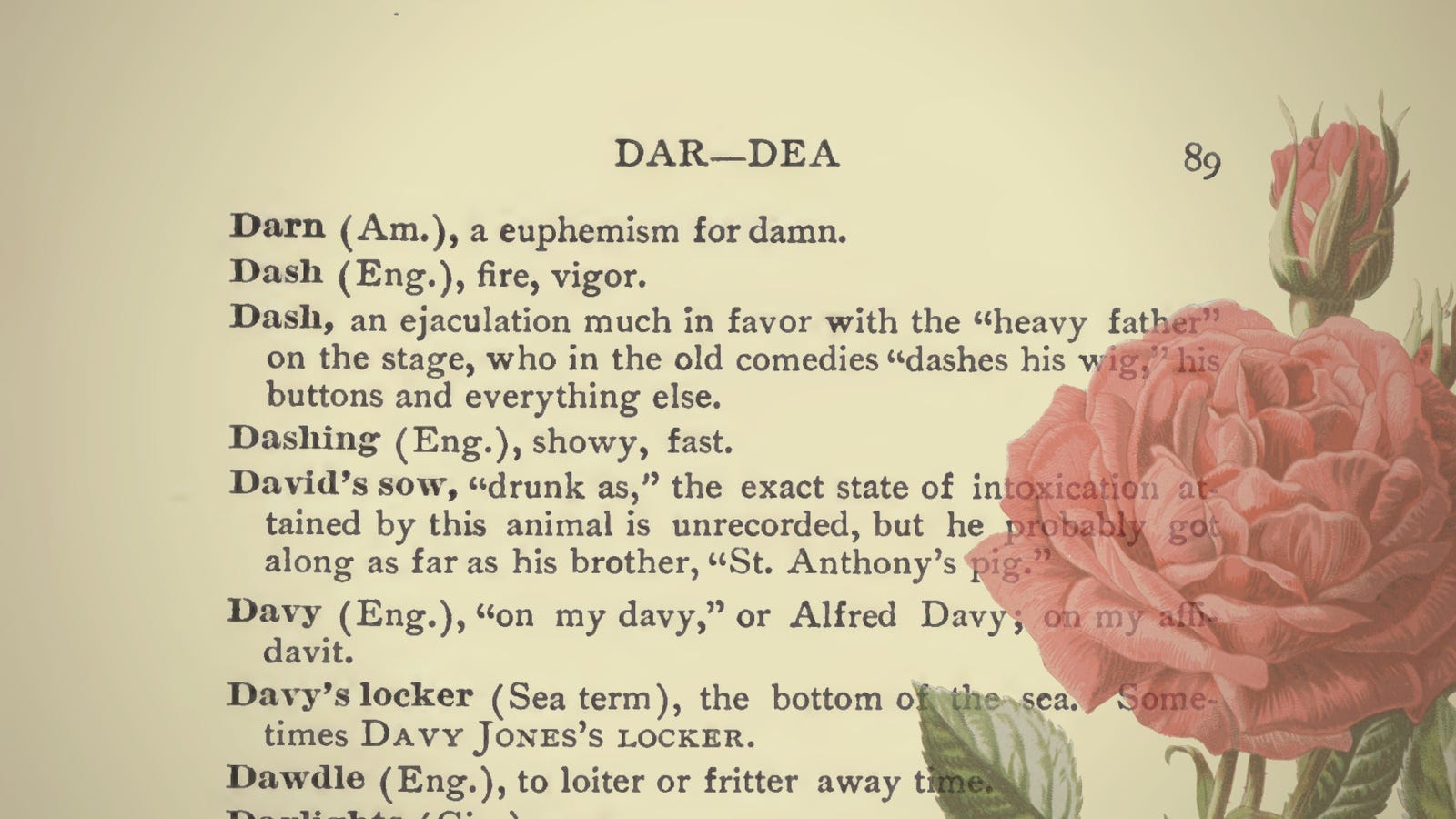
A delightful recent example. English has an absurd vocabulary for being intoxicated by alcohol. Christina Sanchez-Stockhammer and Peter Uhrig recently identified at least 546 synonyms for “drunk” in current English usage. Plastered, smashed, wasted, hammered, sloshed, wrecked, blasted, tanked, trashed, gazeboed. The construction is productive enough that almost any noun can be drafted into service:
A meaningful argument structure construction without any lexical content might be available to speakers, but we conjecture that additional contextual cues as to the topic of drunkenness will be needed to successfully use this construction, the most prototypical form of which is be/get + intensifying premodifier + -ed-form.
Sanchez-Stockhammer and Uhrig, “I’m gonna get totally and utterly X-ed: Constructing drunkenness,” Yearbook of the German Cognitive Linguistics Association 11, no. 1 (2023): 121–150.
Anglophone countries aren’t the world’s heaviest drinkers. We don’t binge-drink more than everyone else. Yet we talk about drunkenness with extraordinary creativity. Whatever this tells us, it’s something messier than the strong Whorf claim. Vocabulary records what a community has paid attention to, including its embarrassments, jokes, evasions, and class-coded euphemisms. Anglophone drunkenness is a culture of saying-without-saying, and the dictionary records the work-arounds.
Nietzsche the philologist
I wish there were more appreciation for Nietzsche the philologist, and slightly less obsession with Nietzsche the dorm-room prophet of the will. His major insight was that the concepts crystallized in our language often diverge wildly from their origins, which is itself an argument agaisnt strong Whorfian determinism. There can’t be linguistic prison-houses if speakers are constantly re-appropriating their inheritance and forgetting where it came from. Even the gazeboedundergraduate is doing genealogy in real time. The original gazebo is gone.
Nietzsche delighted in the gap between phonemes and morphemes. He thought our forgetfulness about origins was part of language’s power, the thing that kept it from sedimenting completely. So I get to drop my favorite line again here. Describing truth itself, the quality some words and concepts aspire to, he writes:
A mobile army of metaphors, metonyms, and anthropomorphisms — in short, a sum of human relations which have been enhanced, transposed, and embellished poetically and rhetorically, and which after long use seem firm, canonical, and obligatory to a people: truths are illusions about which one has forgotten that this is what they are; metaphors which are worn out and without sensuous power; coins which have lost their pictures and now matter only as metal, no longer as coins.
Friedrich Nietzsche, “On Truth and Lie in an Extra-Moral Sense”
The philologist as numismatist. Collecting old coins, studying the worn faces, working out what’s been rubbed away. Nietzsche’s genealogical practice is itself semantic re-saturation. The Genealogy of Morals makes it impossible to think about guilt without thinking about debts. His other works do similar work on good and evil, faith and God, power and authority, creativity, truth, honesty. Some of it lands. Some of it embarrasses. The point of the practice was to induce semantic satiation in tired concepts and offer to re-saturate them, often with his own preferred valences attached. That’s why philosophers keep reading him, and also why he’s so prone to misuse.
Semantic smoothing
Repetition depletes meaning. Linguistic puzzles resist that depletion. Studying the origins of ideas grants them a new lease on life without binding us to those origins, because we are constantly rearranging the linguistic inheritance into new shapes. Fine. What then?
The obvious application in 2026 is to machine-generated language. Emily Bender called large language models “stochastic parrots” in 2021, before most of the public was paying attention. The label has held up because the public problem has become harder to miss. We can produce plausible text faster than we can decide whether it means anything, and the volume keeps climbing.
A machine can write justice, freedom, innovation, community, resilience, care, accountability, or common-sense in grammatically pristine sentences. So can a foundation report. So can a campaign email, a strategic plan, a nonprofit grant application. So can I. The fact that a sentence reads as plausible says nothing about whether its words are still alive. The smoothing strips out the things that make meaning testable. The date. The number. The person who said it. The ugly phrase that does not paraphrase cleanly. The link someone can follow. The pressure of an actual occasion.
Philosophers sometimes call this conceptual engineering or ameliorative analysis: revising concepts so they do better explanatory, ethical, or political work. Treating meanings as adjustable tools can be useful. It can also make language sound like a policy lever. Words can become mechanically fluent, a different condition from contested. Take resiliencein a foundation report: it operates as a positive sound, and whether anyone in the room has the thing the word names is not the question being asked.
Semantic insatiability is the counter-practice. Slowing down around words that have become too available. Recovering enough of their histories, contradictions, and unrealized possibilities to make a tired word resist us again. What I called insatiability in 2024 was a small literary pleasure. Tracing words until they grew strange. Reading etymology dictionaries for fun. It looks more like infrastructure now. Serious words stay alive only in friction with the world, against the steady pull of fluency.
Thanks to Michael Willems for the original conversation. The first version of this essay appeared at anotherpanacea.com in February 2024. Back then, I promised a post on Heidegger’s frustratingly fascist etymological approach as a way of holding “conceptual engineering” and “semantic smoothing” in the same frame. (And yes, I know what frame does to Heideggerians.) I never finished it. Reposting is one way to put myself back on the hook.
Postscript, 2026
I tested this essay by asking a chatbot to rewrite it for Substack. The result was instructive. It made the argument clearer and the essay worse. It foregrounded the AI stakes, which I have kept here. It contributed the term semantic smoothing, which I have also kept. Then it performed the very smoothing it described.
Some of what got cut, with what got left in place:
Stein’s poetry, in my original, reads as “logorrhea.” In the rewrite it read as “verbal static.” A precise pejorative replaced by a tame metaphor.
The drunkonym number was 546 in the original. In the rewrite it became “hundreds.” Specificity replaced by approximation.
The original named Emily Bender and “stochastic parrots.” The rewrite kept the concept and dropped the source.
The original contained a typo, agaisnt. The rewrite silently corrected it. Of course typos should be corrected. Automatically correcting them is still a clue to the whole ducking problem: irregularities get scrubbed before anyone asks what work they were doing. (Agaisnt wasn’t originally mobilized deliberately, but it’s been drafted now.)
What survives that kind of editing is the rhetorical shape of insight without the evidentiary and stylistic friction that made the essay mine. The piece you’ve just read is the version after I undid most of those operations and added the framing the rewrite contributed.
The title also isn’t mine. It came out of a list of statistically improbable phrases in the essay (a list I didn’t generate) and was picked to engage a Substack audience who like the mix of winking vulgarity and pseudo-erudition I’m selling. There’s survivorship bias in this disclosure: if you’re reading it, the title did its job. Authors usually dislike the titles editors give them, and editors are usually right. The graft marks are the most honest thing about this hybrid.